🎧 Du möchtest das Interview lieber anhören? Dann schau bei unserem Podcast vorbei:
02 Anastasija Walcher-Radke of KVL Group & BiB | On the Courage to Speak Your Mind and Colorful Communication in a Blue-and-White Industry
Reading time: approx. 17 minutes
An interview by Carina Hahn with Anastasija Walcher-Radke, Managing Partner at KVL Group and board member of the Verband für Bauen im Bestand (BiB) e. V.
As a managing director at KVL, Anastasija is responsible for marketing, communications and finance. She also co-founded the Verband für Bauen im Bestand and has become one of the best-known personal brands in the German real estate industry herself. In conversation with Carina, she talks about 20 years of brand development at KVL, the association’s unconventional communication and what it takes to become visible as a personality without bending yourself out of shape.
Carina: Imagine you’re at a cocktail party full of strangers. You have to introduce yourself in one sentence - what would you say?
Anastasija: I’m Nasti. Period. That’s it. You don’t have to say everything right away. Then they’ll explain to me what “Nasti” means in English, and we’ll get talking. And that works.
Carina: Podcasts or YouTube videos?
Anastasija: Podcasts, definitely.
Carina: Spoken or written?
Anastasija: It depends. In communication, at work, speaking is my medium. I love phone calls because they get things sorted out. I hate those cover-your-ass emails; I hate answering emails that could be cleared up in two seconds on the phone. Paper is extremely patient - and accordingly, I rarely get around to it.
Carina: Can I jump in there for a second - do you see that as a generational difference, or is it more a question of personality?
Anastasija: I think it’s a question of personality - even though there are obviously differences between generations. Some people genuinely can’t make phone calls. I don’t pick up every call either, and I have trouble listening to my voicemail. The best thing to come along recently is voicemail transcription, so now they arrive in writing. Because I always expect my voicemails to be ambushes. I just find it unbearable to drown in written correspondence.
Carina: What’s worse, in your view: a shitstorm or invisibility?
Anastasija: That’s a tough one, too. As a person, I really like being in the public eye, I’ll admit that. I love being the motivator, the class clown; I really enjoy being the center of attention - no problem with that at all. But I’m massively afraid of rejection, and it’s a real tightrope walk: wanting to be the clown but not being able to take criticism. Unjustified criticism doesn’t bother me at all, but justified criticism really hurts. So: both are bad. If I had to choose - I think the shitstorm is worse, because it means more pain.
Carina: What’s your must-have or go-to when you run out of ideas?
Anastasija: Sports, running. I love going for a run because it clears my mind of unnecessary trains of thought. Breathing in and out and the physical exhaustion help me get to the point - that does me good.
Carina: Last question: what do you love most about your work?
Anastasija: The pay. No, just kidding. What I love about my work is that over the last 20 years I’ve been able to tailor it to myself so that I get both. I’m CFO and CMO - I take care of marketing and communications just as much as this company’s finances. On the one hand, that gives me complete stability and security, because it’s relatively clear and unambiguous. That’s wonderful. And the other side is the creative part. That oscillation between the two - between the highly structured and the creative - is the best part for me.
Carina: Fascinating, because that really brings together two skill sets that many people don’t combine in one person.
Anastasija: Yes, it’s unusual, but that’s probably down to my personality.
Carina: You’ve been with the company for about 20 years now.
Anastasija: Pretty much exactly 20 years.
Carina: Wow, 20 years is a really long time. I was in fourth grade back then. How would you describe the KVL brand 20 years ago?
Anastasija: KVL didn’t really exist as a brand yet. There were three personalities: the K, the V and the L - the V is still with the company. People knew Prof. Kochendörfer because he was a partner at Drees & Sommer and also a professor at the Technical University of Berlin. People knew Jens Liebchen from the university, and Markus Viering also from Drees & Sommer. The brand actually developed through these personalities, because the values they stood for eventually became our DNA. We only ever looked for people and personalities who shared those same values - and through those values, KVL became what it is today. I think it’s a brand that stands for social justice, for sustainability, for excellence, for intellectual leadership - a brand that combines ambition, expertise and science with a deeply human and social mission statement.
Carina: Would you say these core values have remained firmly embedded in the brand DNA throughout those 20 years?
Anastasija: Yes, the guardrails have always stayed the same. The world changes, but you can describe it quite simply - whether you call it social responsibility and sustainability, or loving your neighbor and preserving creation. It’s been the same value principle from 2,000 years ago until today. And when some politicians try to tell us that we can no longer afford sustainability and compassion, I say: then we can no longer afford our society and our form of society either - then we’ll just have to drift into dictatorship. But as long as we want to be and remain a democracy, and want to achieve prosperity within that democracy, we have to live compassion and sustainability.
Carina: Is that something you miss in the real estate industry?
Anastasija: Yes, I sometimes miss it in the real estate industry - on two fronts. One: I find this construction-transition bubble difficult, where I sometimes feel that anything to do with making money gets demonized a bit - because you have to save the world, which I think is bullshit. You can only give from a place of abundance. Our mission statement says: “We’re doing well, and we share that.” You first have to make sure you’re doing well yourself - otherwise you can’t share. And the other side is - sorry for putting it this way - that boomer attitude that you have to think about making money first and that sustainability is a pipe dream nobody can afford anymore. That’s just as much bullshit. As I said: we can’t afford our democracy if we can’t afford sustainability.
Carina: How has your brand communication transformed over these 20 years?
Anastasija: We’ve become much more self-confident. The first ten years of our communication were very sober, blue and white. I think we were mainly busy explaining that we could actually deliver the services we offered at a high standard - because nobody knew us. We had hardly any references, hardly any track record. First we had to show that we could do it. Over the next ten years, we focused on explaining that we do things differently from others - especially within those guardrails of compassion, preserving creation and being good to people and the environment, in other words within our mission statement. And now our communication has reached the point where we say: okay, people have understood that we have clear values. The market has also understood that we can deliver what we offer. And we’re now confident enough to say: we do this very, very well. Now we’re saying: we’ll lead the way for you. We’re ready; we’ll take on the risk that’s everywhere right now on your behalf. This uncertainty - we’re ready, we’re preparing for the uncertainties lurking everywhere in the real estate industry right now. The combination of expertise and values is the foundation for leading the way.
Carina: How do you communicate that?
Anastasija: With exactly that sentence: “We are ready.” With clear, confident colors, with joy, with self-confidence. We’re no longer just blue and white - we’re super colorful, and that also reflects the makeup of our team. We used to be three civil engineers, nothing but engineers. Today we’re architects, engineers, economists and so on - a colorful bouquet of personalities and people, just as complex as construction itself has become. Our team is as complex as it is colorful - and that’s great.
Carina: Would you say certain conditions are needed for a brand to evolve? After all, a brand is more than a logo or a color scheme that changes - it also affects the core, the employees and the essence of a company. What does it take, in your opinion?
Anastasija: We regularly reposition ourselves, which means we place ourselves within a circle of values: what values do we stand for, and how can we express them? One example: I don’t think FC Bayern would take on Dacia as a sponsor, because their values are too different. “Mia san mia”, only the best, always winning the title - and then Dacia, the status symbol for people who don’t need status symbols. That doesn’t fit. And that’s why you can’t communicate that way. With VfB Stuttgart, for example, I think it’s great that they have LBBW as a sponsor, because it’s very down-to-earth and solid. Before that, it was a mattress and bedding company - that didn’t fit at all. You have to look at what you stand for. You can only develop a brand if you ask yourself: what do I stand for, who am I, who are we as a company - and then communicate in that spirit. Just changing the colors, picking random colors or designing a fancy logo is total bullshit. It has to fit your innermost core, both the emotional and the professional core of the brand.
Carina: Why do you think the real estate industry is often so inhibited and reserved in its communication?
Anastasija: Color, joy and zest for life are seen as “not serious” - and in my view, that’s a contradiction we should resolve. Color stands for diversity. Color stands for thinking outside the box. Color stands for recognizing the qualities and qualifications of individual talents. Color also means complexity - not everything is black and white, it’s not so simple that you could just sort everything neatly. You have to be able to deal with shades of gray, or with color. You wouldn’t need a project manager, a boss or a leader if all you ever had to do was choose between right and wrong. To me, color actually stands for a high level of competence, and blue for a one-size-fits-all solution. But blue, calm and quiet always stand for science and seriousness, while color somehow stands for crazy - and that should change. Don’t trust men just because they wear a suit and tie.
Carina: You also co-developed, helped build and are responsible for a second brand: the Verband für Bauen im Bestand. It has this very intense, loud color scheme - perhaps deliberately meant to ruffle a few feathers. How would you describe the brand in three words?
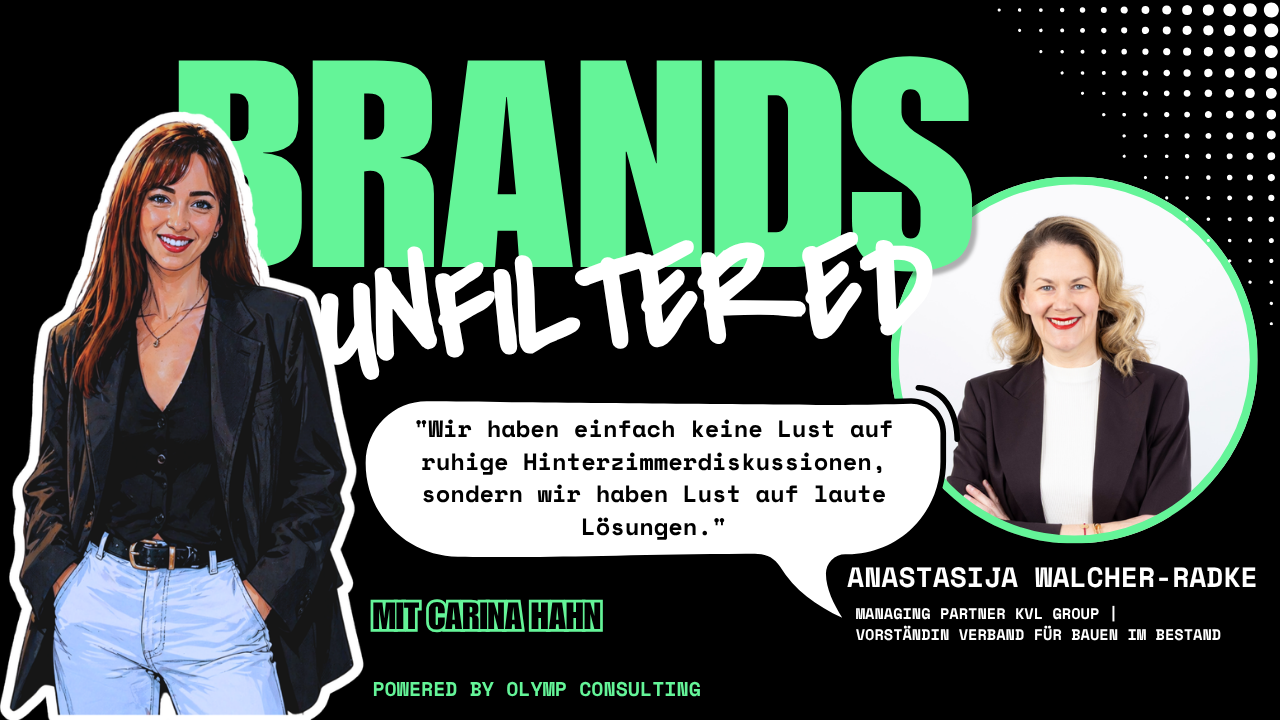
Anastasija: Real. Loud. Solution-oriented. I’ve never thought about how I’d describe it in three words, but I think that sums it up pretty well. The logo and color scheme were developed by [Name], who is also one of our members and a pretty strong player in the market. We deliberately chose this color because it’s shrill, because it’s loud, because it’s not blue. Because it doesn’t stand for calm, for working behind closed doors in working groups, but for going out, talking about problems, exchanging ideas, putting a finger on the sore spot - dissecting our issues in public so that solutions can be found in public, too. The brand is also very female-dominated - just look at the board and the expert advisory council, where women clearly outnumber men. We simply have no interest in quiet back-room discussions; we want loud solutions.
Carina: Why did you deliberately choose such loud, bold communication? After all, it always carries the risk of not being taken seriously.
Anastasija: Of course there’s always the concern that you might not be taken seriously right away or might get pigeonholed. But as a person in a professional context, you also develop a certain self-confidence. Sarah Dungs, the chair of the board and the person who initiated the association - whom I co-founded it with, along with others - always says: only the player with the ball gets attacked. She’s a big hockey player - we’re both athletes. But only the player with the ball gets attacked, and we can handle that because we now have a certain track record. I’ve helped build companies for 20 years. To put it bluntly, I’m not some association rookie who just founded an association and is trying to scrape by on grants. We’ve already proven that our approaches work, and Sarah has built a great framework for how we develop our products as an association. Even as an association, we think in terms of products, like a company. We stick with it, and we hold on to it. We believe in this process - a trusted process - and that’s why we’re so self-confident.
Carina: Did you also deliberately want to provoke a little and shake the industry awake?
Anastasija: Absolutely! Because in our view, the solution lies in the existing building stock. Germany is more or less built. And anyone who doesn’t wake up now and use this existing stock, but keeps tearing down and building new, and doesn’t understand that there’s also huge economic potential in building within existing structures - well, I don’t know when they ever will. Hence the loudness, the wake-up call. If you’re loud, people might take notice and realize: there are solutions for this, too. And of course you can download them from our website for free.
Carina: How do you build substance behind all that? Once you look into what you do, you quickly realize there’s real substance. How do you pull that off?
Anastasija: By sharing responsibility. Sarah and I realized pretty quickly that the two of us, as volunteers, couldn’t develop all the solutions ourselves. So we said: okay, we’ll bring in specialists as expert advisors, and Sarah and I will be the facilitators. We take care of everything around it and make sure the process is followed. But the subject-matter work is done by the experts in each field, and we curate, steer and keep it within a framework so it doesn’t fray or become arbitrary. I think that’s the art: one person makes sure the framework is right, and the experts deliver within it. That’s how we were able to develop products that really help the industry. Our cost framework based on DIN 276 has now been downloaded 7,000 times. Our approach is “done is better than perfect” - we think in perpetual beta. That means everything is in flux, and if I wait until something is finally finished, it will never be born. I’m happy for other people to contribute, give their input and say: I’d do this better here, I’d do this differently there. And then I say: yes, let’s do it that way. So an 80-percent solution, and then we keep working on it together - but at least it exists, and you can work with it.
Carina: What are your most important communication channels?
Anastasija: LinkedIn and our newsletter, which we’re now opening up to the entire construction industry. And we have a WhatsApp channel that works surprisingly well - for members and non-members alike. You can just tune in and get the latest topics on WhatsApp, a few interesting insights, a few solutions, things we’ve seen and loved - so you’re always kept up to date on building within existing structures.
Carina: Was WhatsApp a spontaneous idea, or did you think it through strategically?
Anastasija: We try to keep the threshold low, as barrier-free as possible. Because we do this on a voluntary basis; we don’t want to make money from it. We want building within existing structures to move forward, because ultimately that also makes our work in our actual jobs easier. Hence the accessibility and offering as many entry points into the topic as possible - that was our thinking.
Carina: Last question about the association: would you build the brand and the communication exactly the same way again?
Anastasija: The communication, definitely. But if Sarah and I had known how much work this would be… Our naivety gave us the courage, and now we’re seeing it through.
Carina: Now there’s a third major brand in your life: you. People in the industry know you - very well, in fact. How central is your personal brand to the other two brands?
Anastasija: I don’t think the association would exist without my personal brand - Sarah wouldn’t have approached me if she hadn’t seen me speak at an event and appreciated me as a personality. And of course it’s important to have figureheads - show ponies who get up on stage and are simply loud. But my brand doesn’t work in a vacuum either, because at KVL I have a great counterpart: the person who represents the intellectual side, the science, the know-how and the expertise to the outside world. And through my personality, I can play to the emotional core of the brand really well. I love this teamwork - being able to genuinely support each other’s success: Markus Viering with his expertise and me with my perhaps more emotional approach to the market. We give each other room and don’t try to turn the other person into what we are ourselves. That works really well, and I’m very grateful for it. I never consciously set out to develop myself as a brand, but I’ve always had opinions in my life - and I was never smart enough to keep them to myself. That’s also something my husband sometimes struggles with, because he also works in real estate and is in the public eye, though in an even more conservative sector than engineering. We often discuss: how far can you go, how far can you stick your neck out with claims? And on the other hand: how far do you have to go so that some truths finally get said out loud? I’m very grateful that I’m allowed to do that - to go out on a limb a little further.
Carina: So would you say building a personal brand takes opinions and courage? What other ingredients does it need?
Anastasija: Opinions and courage - and a bit of stupidity, to put all of it out there publicly. Sometimes I really think: oh God, Radke, you should’ve just kept quiet. But it definitely takes authenticity. You have to be authentic, you have to be real. If you change your opinion every two seconds and tell people what they want to hear, it gets complicated. You have to stay true to yourself. Maybe I’m also a bit special, because on the one hand I stand for sustainability and social justice, but at the same time I’m not naive enough to think you don’t need to make money for it. I always try to build a bridge there: I’m an entrepreneur, and I think consuming less is just as necessary. I try to strike that balance. I think I’m a fairly entertaining brand - I think people find me entertaining. And I always think: you need people who open hearts, and others who then put the knowledge or the message inside. I’m a heart-opener, and then there are the people who come after me and add the knowledge.
Carina: So you’re saying everyone has a personality, but you also need the openness to show it? Because you can’t try to be funny or emotional - you just have to be who you are and authentically show that.
Anastasija: Look, I have this CMO and CFO thing going on. That might also be because I have ADHD and autism - which means I sometimes retreat into one area and sometimes into the other. But both areas are extremely valuable for my personality, because maybe I have this impulsiveness outwardly and sometimes say things I perhaps shouldn’t have - and it’s the same in my head. There are no barriers in my head, and that gives me my associative thinking, my quick wit, and maybe also the ideas for doing things differently - and sometimes better - and developing them further. I was simply put where I’m good. That’s my great fortune: that my strengths were seen, not just the challenges that sometimes come with it. I’m extremely grateful for that. There are some things I just can’t do - appointments, for example: forget it, it’s highly unlikely I’ll be on time. But there are people who support me a lot with that, and I’m very grateful to them. It has nothing to do with arrogance, conceit or laziness; it’s simply pure incompetence on my part - just like I can’t speak Serbo-Croatian or Mandarin or run a marathon in under two hours. I just can’t.
Carina: Would you say it also takes support, or the right framework, from the company to be able to build a personal brand like that?
Anastasija: Definitely - and not just for me, but for everyone. I’ve always been the court jester in this company. I’ve always said openly what I think within the company, and it was never held against me. Of course some people are sometimes affected, offended or feel rejected - whatever. But it was always appreciated. And I think that’s how this trust developed over the years: giving each other room to develop as personalities. That’s a real strength of KVL. KVL gives personalities room, because we’ve understood that a uniform company doesn’t benefit the company, the market or anyone else - just as not all plants grow in acidic soil, not all grow in the sun, not all grow in the shade. You have to lay out the bed according to each plant’s needs so that it thrives, blooms and grows. Only then can something great grow out of it. We’re all plants, we all have different needs - and we try to position ourselves in the company’s flowerbed so that we thrive.
Carina: Absolutely - I think that’s also what’s missing in the industry: the courage and openness to allow different personalities, backgrounds, opinions and ideas.
Anastasija: And this is really important: there’s no better or worse. If someone has a quiet personality, works in a very focused way and doesn’t show a lot of emotional commitment to the company because they don’t take part in every activity - that’s completely okay. That’s a personality type that’s neither better nor worse. If someone is loud, puts themselves out there and loves being on stage, that’s sometimes not so well received in Germany - because people think the person just wants to show off. Everyone applauds a US actor for being on stage, but when your own colleague does it, people hold back. Sometimes people turn up their noses - I find this whole topic very difficult in Germany: what you’re allowed to do and what you’re not. It drives me up the wall. Every personality should be allowed to coexist without being judged - you should simply take the positive from it, as long as everything stays within the guardrails we’ve set ourselves.
Carina: That’s a great attitude. How much planning actually goes into your own personal brand?
Anastasija: None, really. I’ve never had a master plan in my life - never. I’ve always just done whatever came up, whatever I saw as necessary. The company needs this, my friends need that, I need this myself - but I never had a master plan. I’d never have imagined I’d end up where I am now. And I’m curious where I’ll be in 20 years.
Carina: True - when you just let life happen, doors open that you could never have foreseen.
Anastasija: And you’re not afraid. I’ve never had existential fears. I always think: well, then someday I’ll just be working the checkout at Lidl - and three weeks later I’ll be store manager, and life goes on. That’s just my attitude. If you can work, you can work.
Carina: Last question on personal branding: do you work with influencers or brand ambassadors as a company?
Anastasija: Not influencers in the classic sense, but we do have brand ambassadors - actually, everyone in the company is a brand ambassador, and everyone is free to post online and put themselves out there. There are no restrictions at all. Of course, we strongly distance ourselves from the far right and far left of the political spectrum; we’d be cautious there. We don’t want that in our context. But Joschi Lerche is right up front as a brand ambassador for stadium construction, Thomas Penske for school construction, and everyone in their own area of expertise - Luana Cortis on Phase Zero and project development. We try to carry our brand into the world as authentically as possible.
Carina: Was there a truly brilliant marketing move you were part of - for your brands or for yourself - that you thought was really cool?
Anastasija: I think there were two things I thought were really cool. One was launching “KVL Cares” - our social sustainability brand, through which we support social projects and the like. That project just brings me so much joy. I think it’s fantastic that the company backs it and provides budgets so we can do what we do. The other is our stakeholder report - actually a totally old-school print medium, but it has a different design and theme every year. We depart completely from our corporate design. Every year it has its own motto, and that’s a lot of fun - because when you announce a motto like that at the start of the year, you act on it. Three years ago, for example, the motto was “Bildet Banden” - team up and form alliances. That’s how I met Lewin, and we started working with TRIQBRIQ. That’s also how I met Annabelle von Reutern, and we got talking with Concular. I’ve met so many people through it that it’s become a running joke: “Anastasija forms alliances.”
Carina: What does the hashtag #bildetbanden mean to you? It even shows up in your LinkedIn profile.
Anastasija: Nobody reaches their goal alone. The world has become so complex and so exhausting - if we don’t support each other’s abilities, celebrate each other’s wins, give each other lots of love and trust, and take on the world’s adversities together, then we’ve already lost. If we’re not willing to stand together as brothers and sisters and reconcile with each other, we won’t reach our goal.
About the guest: KVL Group website · KVL Group LinkedIn · BiB website · BiB LinkedIn · Anastasija Walcher-Radke LinkedIn
About us: Host: Carina Hahn (LinkedIn), powered by OLYMP CONSULTING - marketing for technical B2B brands