🎧 Du möchtest das Interview lieber anhören? Dann schau bei unserem Podcast vorbei:
03 Lea Mishra of POHA House & Zweitbox | On Founding Without Experience, Marketing Under Pressure and Out-of-the-Box Campaigns
Reading time: approx. 20 minutes
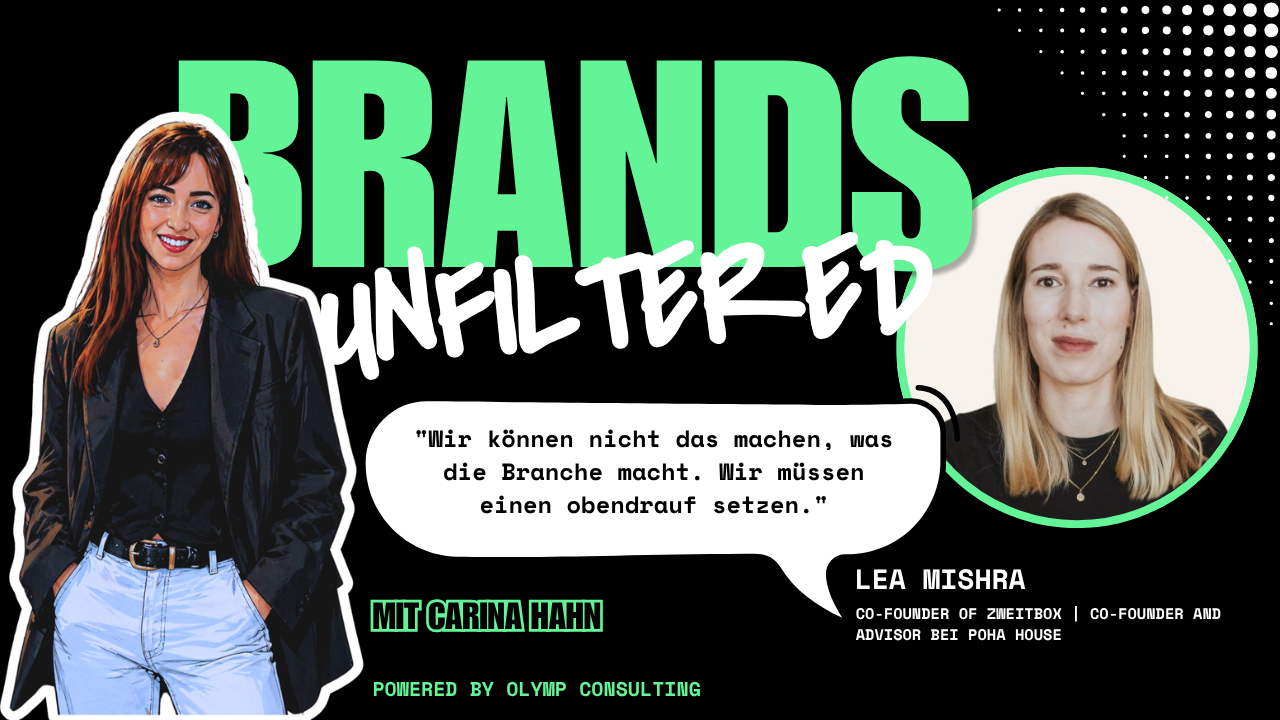
An interview by Carina Hahn with Lea Mishra, co-founder of POHA House and Zweitbox.
In 2019, Lea co-founded POHA House with her brother-in-law - from Hong Kong, at the age of 24, with no experience in real estate. Today the company develops and operates co-living spaces for living, working and coming together under one roof. With Zweitbox, she has since founded her second startup: self-storage in converted shipping containers. In this interview, she explains why, as a generalist, she merged sales and marketing, how her team rented out 300 apartments in three months, and what her AI setup looks like in a deliberately lean team.
Carina: Let’s start with a quick warm-up - rapid-fire questions, as quick and snappy as possible. What do you say when you introduce yourself at a networking event? You wear several hats, after all.
Lea: That changes every year, depending on what you’re working on. These days I say I build offline chains.
Carina: Are you more Team Blog or Team Podcast?
Lea: Podcast. I love podcasts - I wake up with a podcast and fall asleep with one.
Carina: Which would you rather have: invisibility or a shitstorm?
Lea: As a marketer, I have to say shitstorm. Personally, I’d rather be invisible. But for the company: shitstorm.
Carina: Which phrase would you abolish immediately?
Lea: That you need a lot of experience before you can do something. Or that the older you are, the wiser you are. I think that can scare people off and quickly make you feel like you can only fail or get things wrong. In my experience, that’s not the case.
Carina: That definitely takes away some of the fear young people have about starting a company. What’s your must-have or go-to when you run out of ideas?
Lea: Giving ideas space so they can come. In my experience, ideas need space, otherwise they don’t come. Ideas always seem to come out of nowhere - but they only come because you gave them space beforehand. And you do that by immersing yourself in a topic and then taking a break.
Carina: Do you have a favorite place where you get especially good ideas?
Lea: Best of all, on a walk after working out. I exercise in the morning and then go for an hour-long walk. Or in the shower.
Carina: Last question in this round: what do you love most about your job?
Lea: The freedom to design new products. And the impact I hope to have on society.
Carina: Most people who know you immediately associate you with POHA House. How did that come about?
Lea: It’s such a funny story. And I think if you’d asked me in 2020, I would have told it differently. The story changes over time - not because you make things up or leave things out, but because at some point you see differently how it actually happened.
The way I tell it today: I was 24 back then and didn’t have much experience. I’d worked in tech for two years and was sure that was my industry. When people ask me today which industry I come from, I still often say: tech. Which is almost silly by now. I was selling software back then - that was my thing.
At the same time, I’d personally lived in a lot of co-living spaces, simply because I was really keen on living in different countries. I studied in Hong Kong, did my semester abroad in Australia, studied in Italy before that - and I loved living in different cultures. And where do you live when you don’t want to buy furniture and don’t know anyone? In furnished housing concepts, student residences, co-living. That was already far more common in Asia than in Europe.
I came to love it and thought: this is such a cool concept. At the same time I thought: this could be done better. They haven’t solved this well, this furniture somehow isn’t comfortable, these rental terms restrict me. Of course I grew up in a real estate family and actually thought: real estate isn’t really my thing. But my siblings and my brother-in-law were all in real estate.
And then my brother-in-law came to me and said: I’m founding a co-living brand - wouldn’t you like to be part of it? Funnily enough, that was exactly when my master’s in Hong Kong was coming to an end. I’d just met my now-husband - we’d known each other for three months - and had just decided to stay in Hong Kong for him.
Career-wise, that was actually a difficult point for me, because I’m a very ambitious person. Career was always my top priority. I never wanted to start a company, but I definitely wanted to be successful - that was always clear. Starting a company felt more like: nah, that’s a bit scary. But definitely climbing the career ladder. And that wasn’t possible in Hong Kong, I realized that very quickly. I knew it would be more of a step down. I could have sold some software there, too, but it didn’t really inspire me.
And then my brother-in-law said: before you take a bad job, why not do POHA House with me and just work remotely from Hong Kong? That’s how we started in 2019: me in Hong Kong, him in Aachen. He was in the same dilemma, you see. He’s from London and had just moved to Aachen. As an Englishman who doesn’t speak German, he didn’t want to take a job there either and said: I’d rather start my own company. We were both in a new country and said: come on, let’s make something cool out of this. He brought the know-how; I brought the personal experience from the customer’s perspective.
But I have to be completely honest: I had no idea. On day one, I asked my brother-in-law: what should I do? Tell me. From the start, it wasn’t that I knew a lot - it was that I was very organized and very driven and simply good at getting things done. He had the vision; I implemented it. That stayed the case for a long time, and it grew into a really, really wonderful company and a great team.
Carina: A good reminder that sometimes you just have to seize an opportunity, even if you don’t know exactly what you’re getting into. How would you describe the POHA House brand - what makes it special?
Lea: We say: we develop and operate co-spaces for living, working and coming together under one roof. I came up with the word “co-spaces” back then. It was new at the time and is still a term most people don’t know - to be honest.
We actually do more than housing. We do co-working, we have a short-stay offering, we have long-stay, we offer event spaces - by now a whole lot under one roof. So the question was: how can we put this in more general terms? Essentially, these are spaces with a community character - hence co-spaces.
I think we simply live in a time when we meet each other in person less and less. And that makes it really special to have spaces where community develops. That’s still the heart of POHA House: building community here, through events and wellbeing offerings. The concept hasn’t changed that much over the past seven years. Of course we’ve learned along the way, but the core concept has stayed pretty much the same and is still very innovative today, seven years later.
Carina: I’m not in Aachen very often, but I love the concept - I hope you’ll come to Munich, Berlin or Zurich someday.
Lea: Next year and the year after, we’re coming to Hamburg, Essen, Cologne and Düsseldorf. So several major cities are being added.
Carina: You’re first and foremost a founder, but you’ve really devoted yourself to marketing - that became your area of responsibility. How much did you know about marketing back then? And what are your go-to sources for continuing to learn today?
Lea: Good point: I didn’t know much. But at heart, I’ve always been a marketing person, ever since I was young. I always wanted to work in advertising and come up with marketing campaigns. In my business studies, I then specialized in marketing. I didn’t work in marketing in tech, though; I sold marketing software and got a rough idea that way.
To this day, I’d say I’m not a specialist but a generalist. I can do a bit of every discipline but I’m not an expert in any of them. But I think that’s a good thing as a founder. Generally, I love working as a generalist and bringing in experts, agencies or freelancers for the different topics. That’s what I enjoy most.
And I love the combination of sales and marketing. At POHA House, we had separate sales and marketing teams at first and eventually merged them. To this day I can’t decide which one I like more, because I simply love it when these two worlds come together. In practice, I think that still happens far too little at many companies: there are two worlds that think completely differently, don’t pull in the same direction at all and are staffed by very different personalities. That’s still my passion project today. In the early days at POHA, I also spent a long time building the product and working in operations.
Carina: I see that a lot, too - marketing and sales really are like two worlds that sometimes don’t even talk to each other. How hard was it for you to bring them together?
Lea: Bringing the teams together actually worked really well. You could tell right away that people were working with each other instead of against each other. What we still haven’t managed is to find a team lead. Our vision is to have one head of marketing and sales - one person who leads both.
A few years ago I did something pretty funny there, which I consider one of my best career moves. We’d had a head of marketing for a long time, and then that person left. The obvious question was: okay, we’ll post a new job ad and look for someone new - the usual.
I’d gone from “I’m doing everything myself with Yianni, it’s just the two of us” to “I’m a founder and manager” very quickly. But I’d actually skipped the team-manager stage in my career. Then I realized: that’s actually a shame. I’d love to manage my own team, especially on a topic I believe in so much. At the same time, I was critical of myself: am I really better for the job than someone who’s actually spent the last ten years in marketing? But I thought: hey, I’ll give it a try. And so I said: I’m not hiring anyone - I’m the person. I’m now head of marketing and sales.
For me personally, and I think for the company too, that was a great decision. Because I got into the topics in a completely different way. And for me it was great to work directly with the team without anyone in between. We now have a great head of sales and a head of marketing again - two different people, which is completely fine and works really well. But I really enjoyed saying: nope, I’m going to take almost a step down the career ladder. And that allowed me to develop the company in a whole new way.
Carina: From the outside, you have two key target groups - tenants and landowners. Is that right? And how do you reach them? On the tenant side, is it mainly private individuals, or do you approach companies that rent for their employees?
Lea: Both. In marketing I naturally worked more on the tenant side, but over time we brought marketing and expansion closer together and thought about how the two sides could work together more.
On the tenant side, we target D2C specifically, and then we do B2B. Both have pros and cons, and we need both - we can’t do just one or the other. If you have a company renting 10 or 20 apartments, that’s great, we’re really happy about that. There are lots of advantages, and operationally it’s very efficient. But you have no certainty that you’ll land these companies, and of course you have much more concentration risk: when a contract like that ends, suddenly 10 to 20 apartments are vacant again and you have to rent them out all at once. You don’t have that in B2C.
That’s why we deliberately like the combination. The B2C business is super reliable. You know it’s coming. You can say pretty clearly how many bookings will come in each month. We know the seasonal patterns really well, we know which marketing channels work. It’s more effort operationally, but absolutely reliable. B2B is less effort operationally, but there’s no certainty. In Münster, for example, it works really well; in Aachen we’re finding it harder. And in new cities, we always have to re-evaluate.
Carina: How well have you managed to reflect these different target groups in one communication strategy? Does the brand work for everyone - or where were the differences you had to feel your way through in how you address them?
Lea: We approach companies very differently from direct customers. The marketing strategy is completely different, and so is the messaging. Many direct customers are, first of all, genuinely struggling to find housing, and they’re often from abroad. They’re new to Germany, don’t know how to find an apartment and aren’t familiar with the concept. So it’s really about educating them first: what do we actually offer? What are the benefits - for example, that you can make connections?
With employers, on the other hand, it’s often about: how do I find talent faster? And how do I make sure that talent feels at home, wants to stay and doesn’t leave before the end of the probation period? It’s much more about employer branding: how do I position myself as an employer, and how do I make sure my employees feel comfortable and get off to a good start? As an employer, I want my employees to be focused on the job from day one - not saying: I don’t have internet yet, and the boxes I need to unpack are arriving any minute. Or: great that I got the job in Aachen, but I don’t know anyone here and don’t feel at home. Those are the issues employers want to avoid.
Another learning: we always distinguished between companies that already have experience renting apartments for their employees and companies that don’t. Some companies are already very, very professional about it, doing it in a targeted way and have been for years - with them, you really just have to position your benefits compared to other apartments. And then there are companies that need a completely different approach.
Carina: What were your most important channels for reaching people?
Lea: In B2C, the most important channels are the classics: Google Ads and platforms like ImmoScout24 or Immowelt. And above all, events. That’s our core USP, after all: offering an offline experience. We want to make our brand tangible for the target group.
So we often have booths at other events: university events, city events, company events, lots of recruiting fairs, too. Or we host special events in our community spaces - usually themed parties. One was called “Vacation,” for example. We had a ball pit, a hot dog stand, and you could roast marshmallows. We really come up with out-of-the-box events: it’s not just a wine bar with a bit of music - it always has a concept and a theme.
We usually invite HR contacts or the companies’ managing directors to these events and try to show the concept and let them experience it. People from older generations in particular often can’t picture it at all. They immediately think of student dorms and have an image in their heads of what a student dorm looks like - usually not a positive one. And then they come to us and are amazed. We try to make it tangible and something you can experience. That works really well, especially in B2B.
I think the real point - and this has been my key learning of the last few years - is this: it was all new to me; I’d never rented out an apartment before, not even privately. Lots of people came up to us and said: that won’t work, you won’t pull it off. That was the standard response at first. Our very first building in Münster had 300 apartments, and everyone said: you won’t manage it, not at that rent, it can’t be done, you’ll never fill it. In the end, the building was full after three months.
I’m not saying that because we did such a great job - the point was: we had to do it. And we knew that if we ran the same run-of-the-mill marketing program everyone else was pushing, we wouldn’t pull it off. We had to think outside the box. We were under pressure to deliver, and I felt it especially, because I knew I didn’t really have the experience and at the same time had to rent out an incredible number of apartments in a short time. That only works if you try everything that’s in any way possible in marketing.
For example, we handed out fruit with stickers on it instead of flyers. In Münster, we ran a really great out-of-home campaign where we wrote love letters to the city - because people in Münster are so proud of their city. All kinds of love letters to a city. We really had to try everything to make it happen - and that’s how we managed to rent out all the apartments, in record time. Because every single time, the industry told us it wasn’t possible.
The funny thing is: after it worked in Münster, we experienced exactly the same thing in Aachen. Everyone said: sure, Münster is a wealthy city, but it won’t work in Aachen. We have three buildings in Aachen, and it worked there, too - the buildings are full. We simply realized: we can’t do what the industry does. We have to go one better. And funnily enough, I’m experiencing exactly the same thing right now with my new startup, Zweitbox.
Carina: I think that’s also part of the answer to why marketing in real estate is sometimes so bad: there’s no pressure. As a founder, you always have to deliver - in your case, you have to fill the buildings, so you have to come up with good ideas. You need a good product, but also good communication. So the takeaways are: daring to try new concepts, which takes courage - and the offline component to make the product tangible.
Lea: Yes, I’ve always enjoyed deliberately combining online and offline marketing. I don’t think it works with just one or the other. Our world happens online today, and at the same time this is an offline product. It’s a local product; we have to meet people where they are, locally. And especially in university towns, where we often operate, it’s super important to really get into the mindset of the city and build a network there.
During the leasing phase, I lived in Münster for six months so I could meet with literally everyone I could possibly meet with. Just to understand: what makes this city tick? Who do you need to know? Who do you need to connect with? Where should you advertise? Saying with a small team: okay, we’re doing B2C and B2B, online and offline - that’s just a cool experience.
Carina: You recently founded another company, Zweitbox. Could you briefly explain what Zweitbox does?
Lea: We run a very simple but beautiful concept: self-storage facilities made of shipping containers. Maybe a quick explanation of what self-storage is, because I just learned again that 50% of Germans don’t know what it is. That’s very different from the UK or the US, for example, where probably 99% know the concept. Self-storage basically means you can store things but have access to them at any time. That’s different from pure storage. There’s indoor self-storage, which many people may know, and there’s outdoor self-storage - a fast-growing segment right now. That’s what we do.
The idea is: we rent empty spaces, like empty parking lots, and place standard shipping containers there. A lot of shipping containers come from Asia to Europe, but not as many go back - you can imagine why. The goods are produced in China, arrive full in Europe, and the containers then end up with us on the parking lot.
We convert them a little so they’re perfect for the storage use case: a bit more ventilation, easier opening, a digital lock, a light. But we don’t convert them so much that they can’t be used as shipping containers afterwards - that’s exactly the sweet spot. Because containers are an asset you can buy and sell again and again, and they don’t lose their value quickly.
These units are 14 square meters, or 33 cubic meters. We rent them out as units - again to private and business customers - as storage units. One version with shelving, one without. You can book online, drive right up, store your things, open the unit with your phone and drive off again. It’s super easy.
What mattered to me and what made me want to found Zweitbox was the question: how could you build an offline chain in a way that’s incredibly efficient and automated? So that you don’t need much overhead - just a small team and few, but highly automated processes. That’s one USP of Zweitbox: we’re really careful to make sure the entire user journey, as well as our internal processes, is fully automated.
The other USP, which is still rare in the German industry: we also lease temporary sites. Anyone in the industry knows the problem, in retail or commercial real estate: you have an empty site for a few years, you’re waiting for a permit, and what do you do with it in the meantime? We want to offer landlords an easy way to monetize their empty space temporarily. Because we can set up very quickly and dismantle very quickly. Leasing to us won’t make you rich, but at least you’re monetizing the space. And for us, that means very high margins and the ability to generate revenue very quickly, because we can set up fast.
For us, “temporary” means at least three or four years of self-storage at a site - and we give that site a purpose. That’s a good thing to begin with: we create space, which is a rare commodity these days, especially in big cities. I think it’s a concept with positive impact, without us having to build entire buildings and use up lots of materials.
Carina: You were probably able to take a few learnings from your time at POHA House, especially in communication. Were there some key learnings?
Lea: Yes, absolutely. I always say this jokingly: looking back - and you only ever know this once you’re a bit older and wiser - I got an incredible amount wrong at POHA. Or rather, not just wrong: I also spent a lot of time on things that weren’t relevant at that point at all. A year before we opened the first building, I was already working on our cleaning schedule. In hindsight, that was way too early - but at the time, I didn’t realize it.
And that’s a huge advantage now at Zweitbox: I know exactly what the priorities are. What’s needed, what isn’t? It’s a completely different business, but the company is set up exactly like POHA House. I could simply carry over a lot of learnings - the only difference being that POHA House wins on product and Zweitbox mainly wins on price. That’s also a big learning for me: not to overengineer the product but to focus on efficiency above all. Working as simply, efficiently and automatically as possible and implementing a lot of AI. The focus is just different - but otherwise it’s actually very, very similar.
Carina: You probably don’t have a big marketing team at the start - and you deliberately want to stay lean. How do you approach that? What impact is AI having on your setup and your processes, and how do you use LLMs?
Lea: We have a really interesting challenge at Zweitbox. As I said, with POHA House everyone told us at first: nope, you won’t pull it off in Münster - and then it worked. Now, with Hamburg and the other cities, nobody’s worried anymore. Funnily enough, I’m going through it all over again now. In the end there are similarities, but every industry is different, and I’m learning a lot right now. What’s new, for example: at POHA House, even when we were slow, the buildings were full within six months, and I expected self-storage to work the same way. Then I talk to people in the industry, and everyone says: nope, if it takes you 18 months to fill up, you’re fast. That’s a problem for me: I have to be faster. 18 months doesn’t work if my site only runs for three years.
So now I have exactly the same challenge I had at POHA House: I can see how other providers do their marketing. That’s good, I can learn a lot from it, but it’s obviously not enough. We have to do more; we have to step it up again. I honestly don’t know yet how it will turn out: with POHA I know now, here I don’t yet. Maybe I won’t be faster, maybe I will, but we’re definitely going for an approach with the goal of being full after twelve months at the latest. And yes, of course the world has changed a lot, too, and I’m having a blast with it. We now use Lemlist, for example, an AI outreach tool that’s very smart. We also use a tool for SEO and GEO to do prompt research. We’ve set up an AI brain that combines all of Zweitbox’s knowledge and has all kinds of skills: if I want to write a blog post, for example, I can just tell Claude “Write the blog post,” and it gets published directly via Lovable. It’s fun to test and implement these new skills, and of course it allows us to be efficient. I’m curious to see how it develops.
Carina: It’s wild how quickly you get used to this new reality. Two or three years ago, all of this was completely different, and suddenly it’s taken for granted. Alongside Zweitbox, you’ve really built up your own personal brand: you’re very active on LinkedIn and talk on many podcasts about entrepreneurship, family and business, and how to combine them. How much planning goes into your personal brand - is it more spontaneous, or do you make clear plans?
Lea: I simply try to take people along on my journey as best I can. In the end, it’s not so much about any one company, but more about me as an entrepreneur as a whole. Because no matter which projects I’m involved in, at the core I’m about creating new brands that have impact.
Over time, I also realized it’s actually a shame if I don’t pass on my knowledge. Lots of people approached me with questions: what’s the best way to do this floor plan? Which software do you think is best for this solution? And over time, you sometimes forget how much knowledge you’ve actually picked up. When I look back, I also see how often I was led astray by others - and you just don’t know any better, because you have no idea yourself. So many wrong lock providers and software solutions were recommended to me! Not because they’re bad, but because they didn’t fit our use case at all. I wish someone had said back then: nope, think about this again before you go for it.
I wanted to pass on that knowledge. I’ve had the company for years, but I’ve now decided to offer it as consulting, too - very low-threshold and easygoing, basically as a sparring partner. If someone is developing a new housing concept, for example as a property developer, a founder or a co-living operator, they can message or call me anytime, and I do it on a relaxed retainer basis. The idea is simply to have someone for a second opinion. I wished I’d had that so often over the years, because I often took a wrong turn, too.
For example, I racked my brain for six months over whether we should develop our own app or buy one. Today, with AI, you might answer that question differently. But back then, the right answer was: absolutely don’t build an app. I’m very glad we didn’t, but at the time I wasn’t 100 percent sure. I think having that input is very valuable. I don’t do it for a lot of money, either - just on the side - and I find it a cool way to pass on all the learnings of the past few years.
Carina: How often do you find yourself, especially as a founder, really unsure about decisions? That’s also an issue in the industry: many people do their own thing, there’s no real exchange, and people don’t learn from each other - whether it’s about sustainability, technology, new concepts or marketing. To wrap up: what was one of the most exciting or coolest marketing moves you remember? Especially since you said this out-of-the-box thinking is so important for holding your own with a smaller team and smaller budget.
Lea: There’s one we still do to this day. It’s actually more of a sales move than a marketing move, but it’s a funny story, and I still believe it’s one of the best moves for POHA House.
What we do really well - and this is classic marketing talk now - is looking at the entire customer lifetime and examining every touchpoint. We’re always looking for new channels: ah, there’s another touchpoint, let’s try that. We partner with relocation agencies. Or we meet students at the student café where they might be hanging out. We comb through all of it. And in the process, we stumbled on something that works really well. It’s not 100 percent allowed - it’s more typical startup behavior - but it actually works really well: we go to career fairs. Because our B2B target group is HR managers. And where do you find lots of HR managers who just happen to be looking for talent? Served up on a silver platter - at a career fair.
They all have booths there. These are the big companies, and they’re usually local. That means you’ll find exactly the relevant companies in the city you’re in. And all you really have to do is go from booth to booth, and you almost always have the right contact person right in front of you. One career fair is worth as much as three months of outreach. It’s actually genius: it’s always your own city, where you are anyway, and it costs nothing because the fairs are free. A no-brainer - if it weren’t for the fact that career fairs are obviously meant for people looking for jobs, not for people with other motives.
But I think as long as you behave respectfully there - which of course we always do - and go about it sensibly, everyone’s happy with it. We’ve only had positive experiences there and have been able to build a much better network.
Carina: Thank you so much for your insights - it was a lot of fun, and I think there’s plenty to take away. All the best with Zweitbox, POHA House and your own personal brand!
Lea: Thank you! I was super happy to be here.
About the guest: Lea Mishra · Lea Mishra LinkedIn · POHA House website [CHECK: link points to the German version; use the English page if there is one] · POHA House LinkedIn · Zweitbox website · Zweitbox LinkedIn · LHM Consulting website
About us: Host: Carina Hahn (LinkedIn), powered by OLYMP CONSULTING - marketing for technical B2B brands