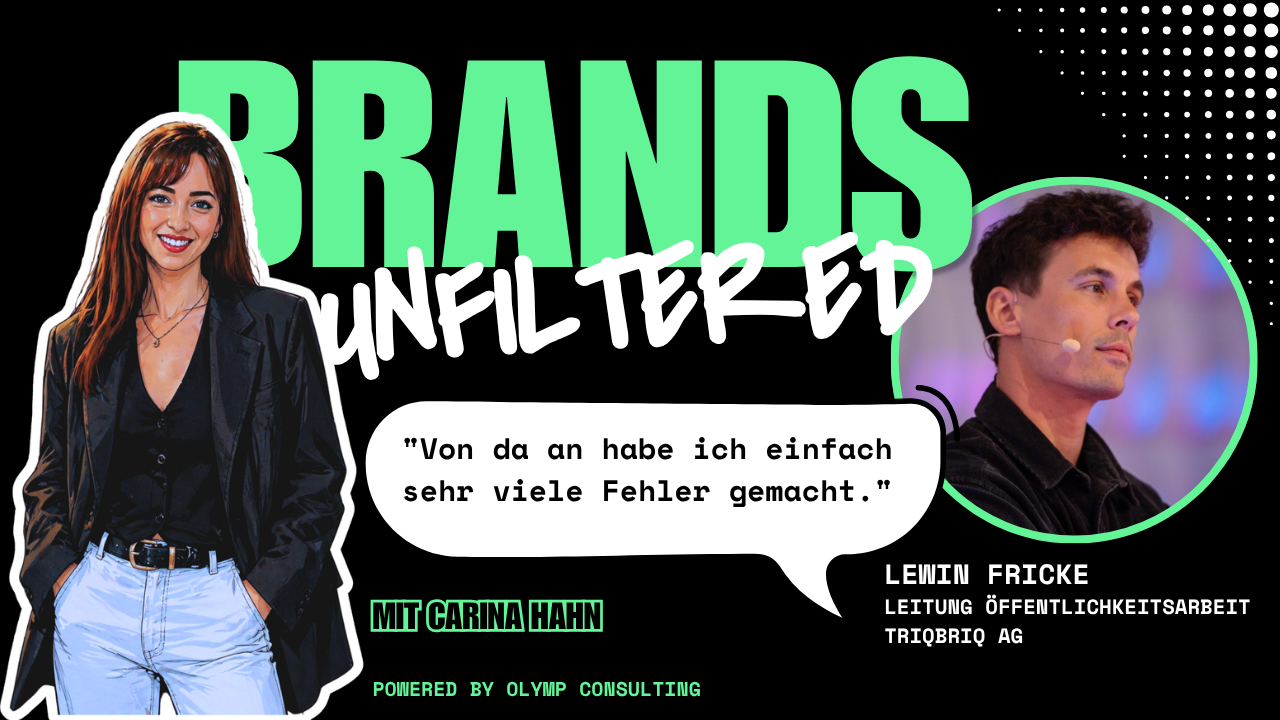
🎧 Du möchtest das Interview lieber anhören? Dann schau bei unserem Podcast vorbei:
01 Lewin Fricke of TRIQBRIQ | On Personal Branding, Authenticity and Going International
Reading time: ca. 20 Minuten
An interview by Carina Hahn with Lewin Fricke, Head of Communications at TRIQBRIQ*
TRIQBRIQ has become one of the best-known young brands in the construction industry - sustainable, approachable and unmistakably tied to one person: Lewin Fricke. In this interview, he talks about building a personal brand from scratch, the role of authenticity in corporate communications, bold mistakes and the startup’s next big steps.
Carina: How would you explain TRIQBRIQ to your grandma?
Lewin: TRIQBRIQ is basically a brick made of wood. We save wood from thermal recovery - or, for Grandma: from being burned. It’s lower-grade wood that would normally end up in Euro pallets or single-use packaging. We use robots to turn it into what we call BRIQs - building blocks made of wood. With these BRIQs you can build walls: load-bearing exterior walls as well as interior walls. And the product is circular from the first day to the last: the BRIQs can be reused again and again. That’s good for the climate and good for the people who live in these buildings.
Carina: How do you become the face of a company - was that a conscious decision for you?
Lewin: Yes, that was a very deliberate decision from the start. Our mantra is: everyone does what they enjoy most - because that’s usually what you’re best at, too. For me, that’s communicating and getting people excited about what we do. So it was clear early on that I’d take on this role. I’m generally someone who loves doing this: being in front of the camera, talking. Two points out of fifteen in my math finals, top marks wherever I got to talk - that pretty much says it all. So it was a very natural development.
Carina: How much did you know about marketing and communications beforehand, and how much was self-taught?
Lewin: At some point I studied political science and media communication, but there you learn things like Luhmann’s systems theory - which doesn’t get you very far in practice. I did an internship and worked as a student employee at MSL Germany, one of Germany’s leading corporate communications and public affairs agencies. But as an intern and student employee, you obviously don’t get handed the full toolbox. I still remember when it all started: I was standing in my mom’s kitchen with no idea what to do. Most of it was learning by doing and networking. You make mistakes, you just get going - and if you’re passionate about it, good things happen. You meet the right people.
Carina: How has your role changed since the company was founded?
Lewin: It has definitely become more independent. In the beginning, I got a lot of support from my colleague Lisa, who heads up marketing and simply had more professional experience. Our founder Max also pitched in on a lot of things early on - I wasn’t really doing it all on my own. By now I’ve developed a routine that lets me handle even more topics on my own with a clear conscience, in what was already a very autonomous role, and I need less support. It has simply become even more independent and proactive.
Carina: How would you describe the TRIQBRIQ brand in three words?
Lewin: Authentic. Approachable. And green.
Carina: How much Lewin is there in the TRIQBRIQ brand?
Lewin: A lot, to be honest. It was a deliberate decision from the start that I’d be the brand face. I’m absolutely convinced that people follow people, not companies. It’s simply more exciting for anyone to follow a person’s journey - to experience their milestones, to celebrate their successes - always backed, of course, by a confident corporate presence. When people think of TRIQBRIQ, they probably think of me pretty quickly, too. But that’s going to change a bit now.
Carina: Is that the plan - building up more faces?
Lewin: Exactly - and not just with a focus on Max, our founder and CEO, but with more focus on the specialist departments, too. Our head of sales, Julian, for example, will certainly become more visible. I think it’s important that there’s still one person who consistently guides people through the story - that will remain my role, and I’m really looking forward to it. But now that our structures are becoming more professional, it’s great that we can give our colleagues the chance to share their own successes with the outside world. It’s much more authentic when Julian talks about a sales win he achieved himself. And as a side effect, you automatically reach more target groups.
Carina: With such a clear brand positioning, how do you manage to reach so many different audiences - investors, customers, partners, employees?
Lewin: It’s tough - and honestly, it’s still one of our biggest challenges. The real estate industry is extremely fragmented. There are private homebuilders who find TRIQBRIQ exciting for completely different reasons than a corporation like the German supermarket chain Edeka, which built a supermarket with us. In between, there are architecture firms, construction companies, specialist planners - all stakeholder groups worth addressing. We try to deliver the relevant content through our various channels - newsletter, social media, website: technical data sheets and feasibility studies for the more technical stakeholders, and clearly communicated benefits for private homebuilders. But here, too, it’s trial and error.
Carina: What role does a shared set of values play in reaching the right audiences?
Lewin: We never formally defined that in some big strategy meeting. Two of our three founders come from professional climbing, so they’re naturally very connected to nature. I come from climbing, too - that’s how a lot of the core team met. I think we’re intrinsically motivated and deeply connected to the planet, which is why we want to offer the construction industry a solution that stays within planetary boundaries. TRIQBRIQ’s entire philosophy is built on that. And because we communicate it as authentically and approachably as possible, it’s credible - even without a written code of values. A lot of it runs on intuition and trial and error. Apparently not too badly.
Carina: Would you say TRIQBRIQ has already experienced a hype?
Lewin: Yes - I’m genuinely grateful for the attention TRIQBRIQ as a brand, our team and our work have received. Sometimes it really does feel like hype - suddenly you’re on TV shows, in print, on podcasts. A crazy ride. Sometimes I’m a little afraid it will all dry up at some point. But I think it will keep developing in waves. There are weeks when not much happens - and then weeks with big milestones coming up. Right now, for example, the launch of our fully automated production, with our international expansion running in parallel. I hope we can keep riding that wave.
Carina: How do you back up the hype with substance in your communications - for example through case studies or best practices?
Lewin: A key part of our communications strategy is letting anyone who wants to watch experience our journey firsthand. Best example: in 2023, the first multi-story residential building was built with TRIQBRIQ. Internally, that was a huge step for us - and for me personally, standing in front of the shell of a building that size was a real goosebumps moment. Of course we communicated it through every channel we could: TV stations, daily newspapers, trade press. We invited customers, potential new customers and investors. Afterwards, fresh investor money came in and we were able to take even bigger steps. It’s the same with every milestone: moving into our production facility, the Edeka supermarket, and now full automation. And we’re always transparent - even when things don’t go perfectly on the construction site. Owning up to a weakness is part of it if you want to be approachable and authentic. At the end of the day, the positive feeling always wins out.
Carina: How do you end up on Die Sendung mit der Maus - and what does something like that actually bring you?
Lewin: (laughs) My consulting classes only cost 500 euros - joking aside. Especially in the early years, I really had to fight hard for attention. I knocked on every door - down to the smallest online blog I could find - and pushed our message with everything I had. And then interesting things happen: we were on the German TV science magazine Galileo, for example, and when I asked the producer how he’d come across us, he said: “I read a piece on reset.org.” Before that, I’d been pretty persistent about getting an article placed there. It ran - and then suddenly Galileo called. That’s probably roughly how it went with Die Sendung mit der Maus, too. My advice to all founders: from day one, find someone who makes sure your message gets out there. If someone fights for it day in, day out, it snowballs a little more every week.
Carina: Can a startup today still afford to do without personal branding?
Lewin: Anyone who does without it is leaving huge potential untapped. I really wouldn’t recommend it to anyone. Maybe there are some defense or security sectors where it’s different - but if what you do is even remotely relevant to others, someone has to be out there sharing it with passion. Absolutely.
Carina: What are your most important channels?
Lewin: For me personally, it’s definitely LinkedIn. For the company as a whole, social media in general. But I have to admit: in the beginning, I massively underestimated the potential of a newsletter. We now send one out every month, and it’s incredible how much feedback I get - from B2B and B2C contacts, but also from people in the media. I completely misjudged that. Then there’s our website, which my colleague Lisa built really well - not just as a business card, but as technical infrastructure for qualifying leads. Whenever a TV segment airs, people call who don’t have financing or a plot of land yet and just want to know what a TRIQBRIQ house costs. That’s a bit like calling Michelin to ask what a Porsche costs. Every one of these inquiries costs time and money. So we built hurdles into the website that make sure prospects signal serious interest before our sales team gets involved. That has made our lead handling much more efficient.
Carina: Would you say your most important channel is the personal brand?
Lewin: That sounds a bit like blowing my own horn, but yes, I think so. I’m the one on stage, on panels and in TV segments, getting the message out there. But quite apart from me personally, I’m fundamentally convinced that it’s much easier for people to follow other people than a company they have no emotional connection to. So: get someone who does this with genuine passion.
Carina: How planned was the way you built your personal brand?
Lewin: Freestyle - to be honest. Day zero was me standing in my mom’s kitchen, not knowing anyone. From there, I just made a lot of mistakes - and that’s actually the beautiful part of the story. That’s my message to everyone out there: allow yourself and your employees to make lots of mistakes. There’s no other way. You have to learn from them - but if you have real autonomy in your role, you can make a lot happen. I think I’ve managed that pretty well in my area.
Carina: Is there a specific mistake that has stuck with you?
Lewin: Yes - I once mixed up gross and net in a sales negotiation. Just imagine that. It was an extremely demanding time, I was on the phone in the car - don’t do that - and I said something off the cuff that set the wrong expectations. In the end, we still found a good solution and the project was a big success. But we left a good chunk of money on the table that didn’t need to be left there. Sucks in the moment - but in the end, it’s often not quite as bad as it feels.
Carina: How do you approach your personal brand today - is it more planned or still spontaneous?
Lewin: These days, I say no to more things. Partly to protect myself: there were phases when I took on so much that, at some point, it just wasn’t healthy anymore. I’m not some snowflake who whines when things get stressful - but there were phases that were definitely too much. Today I ask myself more often: does this really fit what we need to communicate right now? For us, that’s mainly our international expansion and the investor search that goes with it. If an event or a media opportunity doesn’t fit that at least loosely, I’m out. At the same time, I keep questioning what we could do better - I don’t want to develop tunnel vision. One example: I’m currently turning our Instagram strategy completely upside down.
Carina: What have you been getting wrong on Instagram so far?
Lewin: For a long time, we copied our LinkedIn content onto Instagram - and that just doesn’t work. The logic is completely different. Of course I look at what others are doing, and there are channels that are visually very similar to ours and much more successful. For a long time we put Instagram way down our list of priorities because we saw it as a B2C channel that generates lots of unqualified leads. But thanks to the website and our bigger team, we now have infrastructure that can handle a larger flood of leads. We’re at 40 projects, things are moving up - so I’m going to make Instagram much more visual and much less text-heavy. Very short reels that we can also post straight to TikTok. I’m really curious to see what that does for the company account. (After the recording, thanks to this shift, we reached over 3 million people on Instagram and TikTok in under 30 days.)
Carina: Your international expansion - how did it come about, and how much of it was planned?
Lewin: It was clear from the start that we didn’t just want to roll out in Germany, but across Europe and eventually in America, too. That’s down to our production line, which was designed so it can be seamlessly attached to any sawmill or larger joinery. Our scaling model for international expansion relies on independent entrepreneurs in each country producing and selling TRIQBRIQ locally - ideally in partnership with the local timber industry. We’ve now founded a company in Austria, with Matthias Strolz as co-founder - he’s not that well known here in Germany, but in Austria everyone knows him. He co-founded the NEOS party, served five years in the National Council, and he’s a great entrepreneur. Now we want to take this model to more countries: Sweden and Portugal look promising, and we’re in talks in the US - that’s why Max and I were at New York Build in Manhattan. Crazy feeling, suddenly standing there.
Carina: How does the US market differ from the German one? What did you learn at New York Build?
Lewin: As a communicator, I was shocked on the one hand: the visual quality of the booths in the US - at least at this trade show - was alarmingly low. Big companies with really bad booths. On the other hand, I was fascinated by how much the content took center stage. You got talking to people right away, and unlike maybe in Germany, people were genuinely interested: What does your solution look like? How can it be implemented? People don’t think in problems, they think in possibilities. The visual, superficial side hardly mattered. It was all about: What can you do? How do we make this work together? That was a really interesting lesson for me about how other markets work.
Carina: How do you use the international expansion in your communications in the German market?
Lewin: I speak into every microphone and every camera I can find. For us, this is an incredible milestone. TRIQBRIQ has only existed for five years - the blink of an eye in the construction industry. And yet we already have around 40 projects that are under construction or completed. There’s even a TRIQBRIQ house in Chile. That’s crazy. Of course we talk about it on every channel available - because we’re thrilled about it ourselves and because we want to find great partners to keep moving forward with us.
Carina: Why has TRIQBRIQ become a true love brand - even for people who aren’t your customers?
Lewin: I once discussed this with the chief lobbyist of a major real estate group, and he basically mirrored back what you and I have already talked about today: that approachability, that authenticity, that not-polished-to-perfection-by-an-agency feel. That’s our image - and we have to stay true to it. Sharing the excitement we feel ourselves every day, sometimes more, sometimes less: I think that’s the key. Of course you have to become more professional along the way - at some point, posts probably shouldn’t have typos anymore just because you posted them quickly on a train at midnight. The team grows, you get more professional. But what you mustn’t lose is drawing people in and taking them along on what you experience every day. They should get to share our journey a little. By the way, it’s recently become even easier to become part of TRIQBRIQ: we’ve launched a new investment platform where you can invest in TRIQBRIQ really easily. So if you’d like to follow and support our journey even more closely, you’re warmly invited. Just check out our website.
Carina: What was your most brilliant marketing move?
Lewin: It’s the sum of everything - I really can’t boil it down to a single move. And maybe that’s the beautiful part: anyone can replicate it. The most important thing is to just do it. Get started. Be bold. Allow yourself to make mistakes. And always work with others - for example, we’ve already done great things with KVL, where we’re sitting today. Dare to do things, share what moves you - and it’ll be a success.
About us: Host: Carina Hahn (LinkedIn), powered by OLYMP CONSULTING - marketing for technical B2B brands