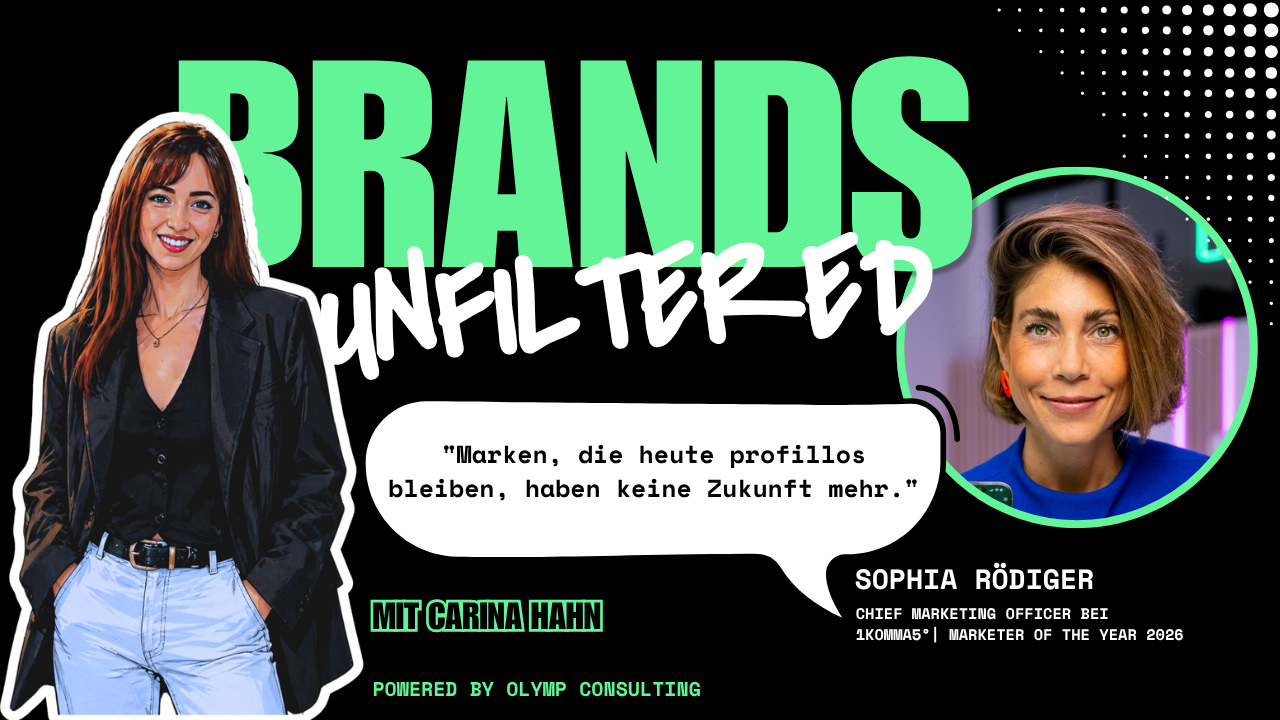
🎧 Du möchtest das Interview lieber anhören? Dann schau bei unserem Podcast vorbei:
04 Sophia Rödiger of 1KOMMA5° | On Electricity as a Lifestyle, the Courage to Take a Stand and Raves as a Brand Experience
Reading time: approx. 25 minutes
An interview by Carina Hahn with Sophia Rödiger, CMO of 1KOMMA5°.
Sophia Rödiger is Chief Marketing Officer at 1KOMMA5°, one of Europe’s best-known energy scale-ups. There, she is responsible for brand, communications and visibility - with the firm conviction that brands without rough edges no longer have a future. She has given the brand a visual identity that conveys hope and a fresh start, turned an electricity tariff into a lifestyle, and hosts the podcast NEW ENERGY TALKS with high-profile guests.
In conversation with Carina, she explains how a low-interest product like heat pumps became a matter of identity, why she uses raves and running clubs as marketing tools, and what it costs to be visible while taking a stand.
Carina: Let’s start with a few rapid-fire questions to warm up and get to know you a little better. Are you more of a podcast listener or a video watcher?
Sophia: Video watcher.
Carina: If you had to choose: risk a shitstorm or stay invisible?
Sophia: Risk a shitstorm. Being quiet, staying silent, having no profile is not an option for us.
Carina: Are you more of an early bird or a night owl?
Sophia: Night owl. I’d love to be an early bird, and I keep trying, but it’s never worked my whole life, and after 38 years I’m giving up.
I get the feeling all night owls want to be early birds. Because that’s how it’s sold: that’s the only way to be successful. By now I’d say: it works out pretty well this way, too. At some point I accepted it - my superpower really kicks in in the evening. That’s when I’m in a completely creative flow, it’s quiet, and no emails are interrupting you. Love to all the early birds, but I’m staying a night owl.
Carina: What’s your go-to when you’re completely out of ideas?
Sophia: The shower. By now it’s pretty well explained why the brain needs that monotonous calm to break through into creativity. Nature is also huge for me. I love taking my dog on really long walks, deliberately without music. And I like long runs, sometimes 30 kilometers, really without any music or anything. That’s the most brilliant thing that can happen when you’re being creative and thinking things through. I’ve found my levers pretty well by now.
Carina: Do you have a favorite podcast, apart from your own?
Sophia: Not really. I like listening to audiobooks, especially on long drives - and I really do drive many tens of thousands of kilometers a year. That way I can listen to entire books. Otherwise I enjoy podcasts now and then, like OMR. And of course I like listening to all of Philipp’s podcasts - shout-out to my Philipp Schröder. But I don’t have that one podcast. I’m not someone who goes in for personality cults; I always listen for the content. You can think what you like about Ben Unscripted, but I sometimes like him too, because I notice there’s a person who somehow catches my attention - not always in a positive way - and I want to tune in. And then there’s a lot that’s business-focused, like Baby Got Business; especially in social media marketing, you’re constantly learning new things. But I couldn’t name that one podcast and say: that’s it, and I’ll love it forever.
Carina: Last question in this category: is there a phrase you’d like to get rid of forever?
Sophia: I don’t have one single phrase. But I’d wish - and I think this is a very strong German cultural thing - that we answered with “yes, and” more often instead of “yes, but.”
In Germany, we’re very much into: “Yes, I hear you, but that won’t work.” Or: “But wait, we’ve already tried that.” If we answered with “yes, and” more often, there would be more creative flow, because we’d be building on each other’s sentences - and, in this case, on solutions.
Carina: I learned that in a communication workshop and have honestly made it a bit of a habit. It’s really nice, because you open up and don’t always have that barrier in your head.
Sophia: And you don’t immediately start clustering and categorizing, along the lines of: here we go again, I can already see 100,000 concerns. That’s often a superpower, too - every entrepreneur and every CEO has to ask: what are the scenarios? Including the pessimistic ones. We have to keep them in view and not gloss over them with rose-tinted glasses. But not immediately in the creative and change process, when you’re just starting with a blank page.
Especially now, when we’re somewhat stuck in Germany. On one side, there are those still lounging in the hammock who haven’t quite noticed that this is the very last train toward transformation. And on the other, those who haven’t really found their room to act yet. I’d wish for more of that forward energy there: more “yes, and.”
Carina: Then let’s dive in. I’ve followed the 1KOMMA5° brand pretty much from the start - on LinkedIn and in all kinds of media - because I found it really exciting. My first impression was: they’re definitely different from what you know from the energy industry.
Sophia: What felt different to you?
Carina: The spirit that Philipp also conveys, the dynamism, the drive to do things differently, and of course the color scheme - you can tell: we want to be seen, we want to be progressive, we want to question the status quo. You joined as CMO a few years ago: what attracted you back then?
Sophia: You described it really well. From the start, I had the feeling that the founders - and the inner circle, the leadership team - really know their stuff. And I don’t mean to badmouth anyone, but there’s a difference between learning a bit about e-commerce and then saying, now I’ll build the next big internet business, and truly understanding a complex electricity market inside out and saying: I want to transform it, it doesn’t work this way anymore.
I sensed that from the beginning: this huge vision, which is truly crazy - and in my view, you need that as a founder, because it sometimes wakes you up at night drenched in sweat. But it was really well thought through, and I found that impressive. On top of that, I noticed that these people were approaching things with a real sense of a fresh start and a radical will to change. That really motivated me.
I then met Philipp at OMR, because we were both speaking there. Walking around and listening to his keynote on stage, I thought: if I’m ever going to be an employee again - I’d been a founder myself before - then I want to grow with this company and achieve big things together. And sometimes, if you stick with it, that’s exactly how it turns out.
Carina: Your day-to-day as CMO is probably very varied. Is there still something like a typical day - what does it look like?
Sophia: Everyone defines the role differently. In our field, brand and brand work are of course a huge building block - and above all, how we communicate: education and information. That also means building trust, building bridges, creating access to something that wasn’t even on people’s radar before. Had you ever thought about where your electricity comes from and what a kilowatt hour costs? And that’s not a bad thing; it simply wasn’t part of our awareness.
And then came the war of aggression against Ukraine, and for the first time we developed a real sense of what oil and gas cost. All in a context that the media made highly politicized, almost polarizing. If you remember: war scenarios, “Habeck’s heating hammer,” Habeck the “heating dictator” or “climate dictator.” There were images and headlines in our heads that were crazy. In that context, we needed to make an impact. That’s the background, and why we chose this path.
We’re characters, and we decided to also put ourselves out there as the faces, the voices, the profiles, and to use our different strengths deliberately. One example: Philipp provokes, but he also has incredible knowledge of the entire electricity market, can put it into context well and has an amazing network. Barbara is our brain behind the technology. That’s how we use our characters deliberately and can make an impact in these roles - depending on where something is needed. I’m very much the connector and above all try to find a way to reach consumers, to stay close to customers again and again - right down to standing in their gardens and bringing these everyday stories to life and telling them.
That’s why my day-to-day is very much shaped by the stage. I get up in the morning - after running with my dog, which is really sacred to me, I even get up earlier for it - and then I always start with some internet time. I have to block it out deliberately: when do I write what, when do I check back in, when did we post so that we generate organic traffic, what do we comment on, what else happened in the evening? I don’t know if that’s the best way to start the day, but it’s important to me - I have to have done it.
After that, it usually kicks off with a team check-in - what’s coming up, for the day or the week - and then it’s stage, podcast or a customer shoot. This week I have two more exciting guests I get to interview myself, and we’ve just launched a sports series with social runs, and we have an intense competition this weekend. So there’s no one typical day, but there’s a lot of interaction, one thing after another.
My real strength is connecting with people and creating an experience that stays with them - that people write about afterwards because it was simply outstanding, something special. On the other hand, it would give me the creeps if you locked me away somewhere for weeks and all I was allowed to look at was Excel sheets. I’d be miserable. Everyone has their own strengths.
Carina: That’s also a good impulse for more conservative companies, where day-to-day marketing often looks very different.
Sophia: Of course. We monitor things just the same: what are we spending on performance, what’s the lead quality, where is the press writing about us, how many people are we reaching, how’s community management going, what are the reviews like? We check all of that every day, too. It’s just that so many agent and AI skills now help us and spit these things out daily. I then look at anomalies and anything unusual and ask my team: what’s going on there? But that’s not my main focus on a typical day - we have experts who sit exactly in those niches.
Still, it should never seem as if that isn’t absolutely essential: it’s the backbone, the machine that has to keep running. Because of our context, we decided to bet heavily on visibility. And I’d even go so far as to say: companies and brands that stay profileless today - too harmonious, too slick, trying to please everyone - no longer have a future. I’d put it that clearly.
That means you have to create rough edges and a profile, and for that you need visibility. How else is anyone supposed to know what a new brand’s three distinctive edges are if we don’t make them visible everywhere? What’s also unique about us is that we chose the path of never getting tired, every single day: talking to one more journalist, going on one more stage, taking the time to really position ourselves consistently everywhere.
Many people have to ask themselves: how else will we stay relevant? Because everything else - AI content, performance ads - keeps getting faster: how you test against each other, analyze with tools, push out exponentially more content. It’s all converging more and more, because everyone can do it and nobody is closing their eyes to it. That’s why the human component is becoming more and more important: the sharpness of your profile, the people, the energy you radiate. Nobody can do that for you, and nobody can copy-paste it.
You can see that in marketing trends, too: reality, creating real experiences, turning shop windows into experiences again with live acts suddenly happening in them, getting the community on the street engaged in your marketing. The billboard doesn’t end at the billboard; it has a buzzer next to it where you do something. We’re seeing a strong trend toward pure physical sensory experiences - sound, smell, touch, action. That approach is already there, and I think it will take some really crazy, creative directions over the next few years.
Carina: I’d like to take a step back to the brand: you have this profile, you have rough edges. How would you describe the brand in three words?
Sophia: Definitely iconic-technical. We have this techie component where you’d say: we’re the Apple of energy, so to speak, or of cleantech.
Value number two is the natural, the feminine. Why? Mother Nature is part of who we are. Wind and sun give us exactly that closeness to the ecosystem, and to what we say: get back into the rhythm of nature. That includes the natural, the down-to-earth, which also comes from our skilled trades. It doesn’t end with you having a nice showroom and attending an event, but with a solar installation or the maintenance of your heat pump, and that really takes trustworthy local craftsmanship.
And the third is definitely: educational, but provocative and pointed. We definitely want to educate and take people along with all their facets, but we say it in a way that’s very clear and sharp. Always smoothing things over and making sure we catch everyone - that’s not it. We’re clear and direct, but in a way that ultimately creates connection. That’s the only way to achieve it within ourselves, too: hard technology on one side, hipster development in the cities, and on the other side trade teams with traditional craftsmanship in every village. Even internally we need that connecting element, and that’s why we naturally attribute it to our brand, too.
Carina: Marketing moves very fast, and everyone leaves their own mark. What have you changed in the three years since you’ve been here - what did you bring that wasn’t there before?
Sophia: We’ve changed everything. My start, after the first year, was of course brilliant timing. We launched in summer 2021, shortly afterwards came the war in Ukraine, the order books were full for the time being, prices shot up. People realized: wow, we’re incredibly dependent - back then it was mainly still on Russian gas. Independence: how does that work? I’ll put a solar panel on my roof. That’s how it started. That meant we had installation backlogs up to the ceiling, and at first nobody believed we really needed much marketing. These waves often aren’t entirely natural, and so a company doesn’t necessarily grow up organically either.
So it became clear: we have to do something. We have to become more independent instead of buying leads from others. We need our own sources. That’s why, early on, we built performance heavily into our own channels - Torben Diekmann, our Chief Growth Officer, did that, with the website as our strongest channel. None of that existed before: when I arrived, we didn’t even have much stock material - not a single solar installation in our photos.
What I set out to do above all - together with Philipp, who also has very strong impressions and images of where we want to go - was to come up with a visual identity. How do you stage all of this without doing it the way green politics would, or the way Yello Strom does with sun and solar? We wanted a color palette that stages Mother Nature and the sun - in color theory, purple stands for setting out toward something new. We wanted to create something aesthetic in which people feel hope: hopeful energy. And to say: hey, this is something beautiful, a beautiful lifestyle, I want to be part of it.
What I also firmly established: on the one hand, the connection to people in their everyday lives, that real closeness to everyday life. And on the other, turning an electricity tariff - actually a low-interest product nobody thinks about - into a lifestyle. A new, cool lifestyle we’re all up for, that’s somehow sexy. That was more or less Philipp’s brief: “Sophia, make it sexy.” I think we pulled it off, and it’s a vein we tapped together. Because it’s not just me; it’s all the people who make an impact every day, right down to our trade locations driving around in our vans. They’re among the most important rolling billboards, and you shouldn’t underestimate them. And that’s what I love so much: that we’re achieving this together and really living this brand, right through to our customers. I never would have thought people would put signs on their houses saying they’re Heartbeat pioneers, that they’d invite people to barbecue parties and say: come down to the basement with me, I’ll show you my system. It’s like the old Tupperware parties. Those were ideas where we said: let’s give it a try. That it took off like that, and that people identify with it so strongly that it’s almost becoming a new status symbol - I find that unique, and we’re very proud of it.
Carina: That’s what’s so exciting: it’s a topic nobody ever had on their radar, and suddenly it becomes a matter of identity - like Apple devices. Suddenly it’s cool to be part of it and a pioneer. My perception used to be: the energy industry is monotonous, big corporations, nontransparent. In your progressive communication, were there also difficult experiences, where something wasn’t immediately well received?
Sophia: Of course we don’t go in and say: let’s push for a shitstorm now. But we’d rather try first and can still act and optimize afterwards. Our ambition is always to be a bit ahead as the first in the industry - by now, others are watching too: what are they up to now? Still, there are many great names we draw inspiration from. Octopus Energy, for example, does a really great job when it comes to transparency toward customers. Our learning area number one comes from 1KOMMA5°‘s founding spirit. The name itself is already a provocation and a bold claim - in your face: think about the climate target. By now I get asked on almost every stage: are you going to change your name? No, of course not. This tipping point remains relevant, no matter how far and how long we overshoot it. We should keep reminding ourselves of the symbolic power of exactly these tipping points.
So we come from provocation, and the theme was: what’s your contribution to the climate? Accordingly, at the beginning we talked a lot about our CO2 avoidance strategy. Then we realized: all well and good, but nobody buys from us just because we come with that bold claim. In market research and surveys, nobody would say they don’t want to invest in that, but it’s only a side motivation.
We found out the main motivation pretty quickly: three and a half years ago, Der Spiegel framed us as “Germany’s cheapest electricity tariff.” We were one of the very first with a truly dynamic tariff - and then people practically broke down our doors. It was clear: in the end, the lever is “I want to save on electricity costs.” And that’s completely fine; I don’t want to judge at all - everyone finds their own way into behavior change and electrification. That was a real learning: we don’t need to tell the story so heavily through “you’re avoiding CO2.” We saw how price-sensitive people are - price and solar had to be the keywords, and then the rest could follow. We love our technology, we love our AI behind controlling the power flows in your home. But that’s not what activates people at the first click, at first awareness. We had to learn that and make sense of it ourselves. After that, things flowed, and we changed our claims - which is why today we say: the cheapest and cleanest electricity.
The second big topic is profile and having a sharp profile. I’m convinced that taking a stand is exactly right, but of course it’s a challenge. When you sometimes take on an EU Commission, sometimes file a lawsuit or criticize the government more harshly in your statements - right down to a Philipp Schröder who voices his opinion as CEO - then you have people who like that and people who don’t. Sometimes we suspect or know things behind the scenes, or map out a path that not everyone likes the taste of up front.
Because of this strong identification, many people think they know Sophia, Barbara or Philipp personally - and that does something to you. That’s the risk when you show yourself as very approachable, truly open with all your opinions and mistakes, right down to typos, because we do things ourselves. That’s authentic, that’s what our brand stands for, and it leaves you very exposed. Those are learnings where you sometimes think: okay, maybe we shouldn’t have made quite such a big deal of one thing or another.
But holding your position even when it hurts - we showed that especially as the climate narrative lost momentum. For a while, we didn’t get much applause for it, especially when you invite Robert Habeck onto the podcast, or a Maja Göpel, or climate scientists. It goes as far as us collecting the most outrageous comments: we get death threats; people have wished a stroke on me. You’re allowed to talk about this side of visibility, too. We still hold our position, support each other and build each other back up. You don’t have to be everyone’s cup of tea, and these days I’d rather be noticed and show a profile. In my view, that’s exactly what we need from entrepreneurs, from founders and above all from brands.
And one more point where we perhaps look at brand work a little differently - I get criticized for this again and again: we see our brand as more agile. I keep bringing that into my discussions with Philipp, too. Many would say: no, a brand has to stand firm, independent of geopolitics and everything else. I think that today, entrepreneurial networks, business models and the business plan, right through to the brand, have to stay more agile, because we’re changing so fast and have to react so quickly to global developments. Of course there are stable components and values, but the core measures and the narratives have to stay flexible. We’ve proven that again and again in our own small disruptions, too.
Carina: I’d like to talk about AI. Authenticity is very important to you, and at the same time AI is a big topic in communications. First: how big is your marketing team at the moment?
Sophia: If you add everyone up - we also have our powerhouse in the seven markets we’re in - it’s around 50, including working students. That covers everything from performance to design and video, which we also have in-house.
So the teams aren’t huge, but they’re usually very sharp, with truly outstanding experts - the crème de la crème in their field. That’s crucial: it keeps us fast, we work in squads, and the powerhouse assembles itself for each project.
Carina: Where do you use AI, how heavily, and how do you make sure you don’t end up with AI slop? In other words, how do you handle quality control?
Sophia: There’s no area without AI in it - and above all, it’s being pulled into the process.
If you break it down: the performance and growth side optimizes itself ruthlessly through analytics, but also through agent skills - meaning automation, just to get the volume out at all. Where we used to need eight hours for certain content pieces - with research, writing, identifying topics, polls, ideas - the teams are now so fast that they deliver them within a few hours, in several batches. The same with A/B testing: screen the competition, filter out the best stuff, prompt a quick AI spot on top, release it, test against it again. It’s incredible how high-performing the teams have become. There’s a huge amount of analytics behind it, but also the simplest things: watchlists of people who write about you, especially those who sometimes make negative videos. Every morning, certain skill agents screen our entire social media orbit and say: hey, John Doe talked about you, and not positively in the title. That’s how the machine gets going every morning. For our videographers, editing without AI is now unthinkable, and the same goes for designers: all those repetitive tasks from the past have been replaced, and that creates incredible speed. And of course we also use a lot of generative AI.
We’re learning a lot this year and have said: at the end of the year, we’ll draw a line and write a manifesto. Especially when it comes to trust and customer content, we’re careful. We were among the first to tell these everyday stories from the neighborhood with real customers. People who really stand up and let us into their lives. We don’t want to destroy that on the trust side. That’s why we’re careful with customer faces: when do we simply prompt an AI face, how do we have to label it, how do we really disclose every little thing so consumers out there are informed? We take a very transparent approach there, in line with our brand values. You shouldn’t underestimate what false impression - of beauty, for example, or of staging in general - can form in people’s minds. We’re feeling our way into these topics right now and writing our manifesto on them.
And yes: mistakes happen, too. Sometimes friends write to us: hey, have you seen your logo in that ad? That wasn’t prompted quite cleanly. It happens - then we have to react immediately, get better and sharpen the prompts. The teams are building up their skills everywhere right now. But closing your eyes to it: no chance. Anyone who doesn’t use it today is simply gone.
I tell creatives the same thing, meaning design or video: if you don’t know how to prompt, someone will overtake you and make your job obsolete. That doesn’t mean the craft of video and lighting design no longer exists - on the contrary, I need exactly those people for prompting, because only they know how to describe a look or a style in the first place. I wouldn’t even know what to call it. But they have to use it, and we’re pushing everyone in that direction. I also expect people to be up for nerding out in the evenings and watching tutorials - and everyone does.
Carina: Your own personal brand is also very strong. Within 1KOMMA5°, you’ve also built your own podcast, NEW ENERGY TALKS. How did that come about, and what’s the goal of the podcast for you?
Sophia: A lot really comes out of exchanges with our founders. That’s so important, because they keep pushing you to think at the next level. The podcast is now over two years old, and when we started it, it had always been a bit of a dream of Philipp’s that we’d build our own media channels where we create quality content ourselves and take education seriously.
That was always important to me: if we say we’re a movement, we have to show what that means outside of PowerPoint. That meant sports and social movement in the sense of social clubs. And if we write “education” and say we want to inform people and do adult education - what does that mean? It means webinars, info sessions. Every evening, we hold info sessions in showrooms somewhere, right down to the smallest villages. And the podcast is a medium where you deliberately make space for a deep dive, for more words than just the claim at the top of the ad or the banner.
The balance was important to us: on one side, the short format, which has to be really crisp and heavily condensed, and on the other, room for deep dives. A podcast is simply great for that. We also said: we deliberately need these debates with different opinion leaders on energy and the electricity market.
That’s how it all came about - we wanted to combine three things: timeliness and relevance. Some fame, too - we do want people who really have something to say. And of course presenting our niche topics in an exciting way. Probably nobody would say that Ms. Reiche’s EEG is the most exciting topic in the world. But you can make it exciting, you can ask the right questions and sometimes annoy your guest and grill them.
In the end - and this is the bottom line - the goal is for everyone out there to find a way in; hence the hashtag #einfachmachen (“just do it”) that we sometimes use. Why should I think about my own electricity? Not just where it comes from and what source is behind it - oil, gas, sun, wind - but also: how can electricity work for me? If I use it intelligently, I can even make money with it. That’s a complete paradigm shift, and we want to make it accessible. But it’s insanely complex: it’s not just plugging into the socket and off you go; it takes understanding and access so that everyone out there gets it and wants to join in.
That’s why we bring in lots of community questions, look at what’s on people’s minds on social media, look at posts where one person may have taken shots at another, and ask our questions accordingly. We’re proud that people like Robert Habeck have been on our show - after leaving politics, he did his first podcast as a private citizen with us. It makes us very proud that people want to talk to us. And we’re still only getting started with exciting personalities.
Carina: How strategic are you about your own visibility? Do you really plan it, or did you stumble into it?
Sophia: Good question - and I’m honestly the worst adviser here. I’ll probably shock a lot of people when I say: I have no strategy and no plan behind it. On the one hand, maybe that’s the secret recipe; on the other, there are far more strategically built and very, very successful personal brands.
I’m not just a face and a personal brand for the topic. Above all, I want to move this brand forward, this communication, together with the teams who work alongside us, right through to the product areas, and really create impact. It wouldn’t have been enough for me to say: Sophia, you have a personal brand now, people know you, you get invited to cool events and you’re well known on social media. That’s just my personal opinion, but that wouldn’t be enough for me. I want to create real impact - to help shape a company that I can say will stand for a fresh start and for something new for the next 10, 20, 30, hopefully 100 years. For energy, which will look completely different again in 100 years.
That’s what motivates me. Right down to what we talked about earlier: out into the neighborhood, into the garden. Those stories where I can tell people have put an incredible amount of thought into realizing a project like this with us. It’s an investment of time and money, after all. The stories that come out of that move me deeply, and I want to tell them. I actually enjoy giving other people the stage and coming up with formats much more. That’s where I’m creative: looking at trends left and right, drawing inspiration and asking how a new format could work in our context to let other people shine in all their greatness.
Of course that has an impact, too, when you enjoy it, mean it and it really suits you. People are drawn in and notice: they mean it, and this woman lives it, too. I think being real really resonates, especially in a world where more and more glossy content is staged and you’re sometimes fed up after seeing the same trend for the tenth time. That’s where we say: we’re not jumping on that bandwagon, we’re staying true to ourselves - even if it’s not what’s going viral right now. But it’s my line, and I think my line attracts a lot of people. That’s where we’ve positioned ourselves, where I’ve positioned myself. So my own growth is more of a side effect. I wouldn’t enjoy pushing my personal brand as a personal brand. I want to push a topic forward and have impact on that level. And if that apparently goes well together and people say: hey, you and your story and the person behind it are interesting, too - then I’ll take it. But I don’t see myself as the most interesting part of it; I see myself as the voice that tries to make it approachable for people, explain it and above all show its sparkle. Because I see it, I feel it every day. I think that’s also why you get to the point more clearly, don’t get sidetracked, don’t get carried away and lose touch with reality. That’s what I wish for in others, and that’s how I want to be, too. And I think that’s exactly what connects all of us here and makes 1KOMMA5° so strong.
It’s about the cause. Then a lot of that elbows-out theater falls away, where it’s only about individual interests and power struggles. You know those political stages in big corporations and companies yourself - I’ve been on them and worked in them, too, and I learned a lot, I have to say. But I don’t want that. When it’s about the cause, you fortunately don’t waste so much energy on whether it’s about your own ego.
Maybe that’s also my appeal to our society: I’d really wish that, right now, people on all sides set their egos aside and asked what it’s actually about - the cause. I miss that in many debates. You can feel so strongly how something is being staged on a hidden level, how theater is being played. I think it would free up a lot of energy for what really matters if we let that go.
But it also means a lot of work and constantly getting involved yourself, because you haven’t built something with crazy strategies and Claude Skills that runs on its own. That’s not me. Maybe you could optimize that. I take every tip and let myself be inspired by great people; I have role models, too. But in the end, my path is: I want this topic to move forward, and I use what I do for that.
Carina: What I’m hearing: your secret ingredients are genuine enthusiasm for the topic and being the kind of person who has no problem going out there and sharing that passion. And then simply trying things out and learning along the way.
Sophia: What you still need: I manifest my big goals. I’m not someone who meticulously plans every day what she posts and how she does this and that - I’m not that calculating. But when I say: hey, I think that’s awesome - Philipp, for example, is doing his first TV appearances on Galileo and the like, on a very factual founder-and-CEO level - then I say: I’d actually like to go on breakfast TV, too. Where are the lighter formats that really reach the mainstream? Let’s make energy more humorous and lighter for once. That would fit my profile perfectly. We do manifest big things like that - just the plan for how to get there isn’t calculated out for every single day.
Carina: That can be encouraging, too. Many people worry about coming across as show-offs - and that’s exactly what you’re not doing when you’re truly pushing a topic forward.
Sophia: Exactly, and that’s often a false image we have in Germany around visibility. Being visible with your topic - with your mouthpiece, your visual language, your gestures, your facial expressions - doesn’t mean pushing yourself into the spotlight everywhere, but bringing quality.
Of course, by now I have more and more levers so I don’t get drowned out on a panel, because I know which statement I’m going in with. You learn that, too. Maybe someone will then say: that woman always has to have her say. But my goal isn’t that Ms. Rödiger always has to say something; I want to land the sharpness of my message, and you have to figure out how to get it in there. That’s exactly the difference. It’s not about putting my ego in the spotlight, along the lines of: did you see Sophia was at that event? No - our topic has to be seen and heard, along with our stance and the sharpness of our position on a topic on stage or on a new law. Then you don’t need to worry about constantly pushing yourself into the spotlight and always looking for the next stage just to be part of it. That has nothing to do with ego.
Find your topic, the one you want to stand up for every day. The price, of course, is that you commit to it every day, and that people have more and more expectations of you in that context - for us, energy, climate, renewables. People develop an image of you, a symbolic power, and then certain things no longer fit that image. You have to go along with that, and that’s why it’s so important that you truly stand for the topic. If you don’t stand behind it, it hurts badly. And I’d be ashamed, too, I have to say. I couldn’t play a role for something I don’t wake up to every morning and fully stand behind. Then you also don’t feel it’s annoying or draining your good energy, because you don’t have to pretend on stage.
I’d love for us to rethink how we think about visibility, how we make topics visible and, of course, ourselves along with them. And not everyone has to be up for it - that’s fine, too.
Carina: I often feel there’s a difference between more conservative companies in the B2B world and these lifestyle brands, which have a lot more passion behind them. Yet the other topics are just as exciting. So: have a topic you’re passionate about and then go out there with it.
Sophia: Exactly - and we’re talking a lot at brand level now. Break it down for every single listener: are you aware of your own brand? That doesn’t mean you have to do a whole brand development process right away. Start with your first three hashtags - okay, hashtags are already out again - so, with your three words, the way you asked me about the brand in three words earlier. What are your three words? What do you want to be known for in a company, for example? I think that’s really important: how am I supposed to know to pick up the phone and call you if I don’t know what you stand for?
Especially in large corporations and large groups in society, it’s really important to talk about it and also present what you want to be known for. It’s a given that everyone gives you a profile, a brand - our brains are wired to categorize. We may train ourselves not to keep opening and closing the drawers, but we do pigeonhole. So if you’re going to be labeled anyway, you’d better shape the label yourself and write what gets stamped on your forehead instead of leaving it to others. That’s why I always want to encourage people to think for themselves: what are the three things I want to be perceived for?
And that doesn’t mean you have to reveal a lot about your private life. I hear that a lot: yes, but then you have to show so much of your private life. No, you don’t. Personal and private are two completely different things. I can let everyone share my personal life, but nobody knows anything about my partner, for example. There are levels of visibility that are really important for bringing a brand or a topic into the world.
Carina: Last question: was there a truly brilliant marketing move you were part of, where you’d say: that was exceptional, it stuck in my mind or it was a lot of fun?
Sophia: There are lots, because - as I just said - with new formats we’ve always looked around the scene: what can we borrow from elsewhere, where can we stage something new?
What we talked about earlier, that Tupperware party effect - the Heartbeat parties in every postal code across the country. That was a real aha moment, because I was skeptical at first whether it would work: whether people would really open their doors and let you look around. You can stage consultations in a showroom; people look at the devices there. But being allowed to see a live energy system at real people’s homes - I thought: let’s see if that works. But I’d like to mention something else, to add one more source of inspiration: our event strategy. It really is unique. Investing in organic marketing and events is a cost factor at first, and not every company is thrilled about it on its balance sheet. For us, it’s unique because we realized: you need these deep spaces where people experience and talk more intensely. Whether it’s the info evening in the showroom, where you really get into the topic, where people sit together and we get to bust all the pub-table myths about heat pumps and solar.
But it’s also about experiencing your brand on a different level. What do I mean by that? We’ve thrown wild raves, for example - to the point where Manager Magazin reported on 1KOMMA5°‘s “kinky parties.” We said: we’re not taking the standard route, we’re not going to these standard events and renting an expensive trade fair booth. We’d rather team up with other partners who, honestly, also find that a bit too expensive, and do our own thing. That’s how a bold rave came about, now heading into its second and third year, where partners trust us and give us money, and we throw a really wild party to show: this is about a feeling, a way of life. Our party is a cool party - come dance with us instead of fighting old industries. We’d rather stage and open up this new lifestyle than keep looking to the past, and we borrow a lot from other industries to do that.
The second example is sports. And that may need a quick explanation. You might think: why are they going crazy and doing sports events now, too? Of course we looked into it. Point one: what connects people - old and new, village and city? Sports, right down to the youth club in the village. Sport is first and foremost movement, something that connects people, and it often brings everyone together. You don’t even have to speak the same language to play soccer together. That’s point number one: this connection, these bridges between the most diverse subcultures.
And we’ve always said: 1KOMMA5° is a social movement. Then you have to take that movement to the streets and bring people together - in a running club, for example. Just put on your running shoes and go. On top of that: people who do sports are usually people who set goals, overcome their inner couch potato and approach their lifestyle sustainably - whether it’s nutrition or whatever. That puts you pretty close to the topic: how do I treat myself, how do I treat my environment? And suddenly you’re at wind, sun and renewable energy.
That doesn’t mean that because you ran with us yesterday, you’ll order a solar system tomorrow. But maybe we’re on your mind, you recommend the topic to your parents, or you think of us in three or four years when you build your first house. That’s how we reach people through other contexts who fit us and whom we ultimately want as customers, too. We’re proud of that: that we think outside the box - which of course means an investment first. And I’m very glad that we keep getting the trust to try things out.
We started that last year, and the whole running club and biking club thing has since gone through the roof. We hit the right moment and are reaching thousands of people; soon we’ll have our biggest community run yet, with over 500 people. Those are all brand impressions, and that’s the beautiful interplay: on one side AI, speed and performance; on the other, creating real experiences. I’m extremely proud of that.
Carina: What you’re creating are exactly those emotional connections - a sports experience or a rave is full of emotion, and that spills over into the connection people have with you. That creates really strong touchpoints. This was a very, very inspiring conversation. I’m a big fan of your brand - thank you so much for the insights!
Sophia: It was a lot of fun, and I’m glad you got some insights out of it, too. Thanks also for your feedback on how you see us - we keep learning when someone holds up a mirror with a different perspective. There’s a lot more to come; we have big plans.
About the guest: Sophia Rödiger · Sophia Rödiger LinkedIn · 1KOMMA5° LinkedIn · 1KOMMA5° website · NEW ENERGY TALKS (podcast)
About us: Host: Carina Hahn (LinkedIn), powered by OLYMP CONSULTING - marketing for technical B2B brands