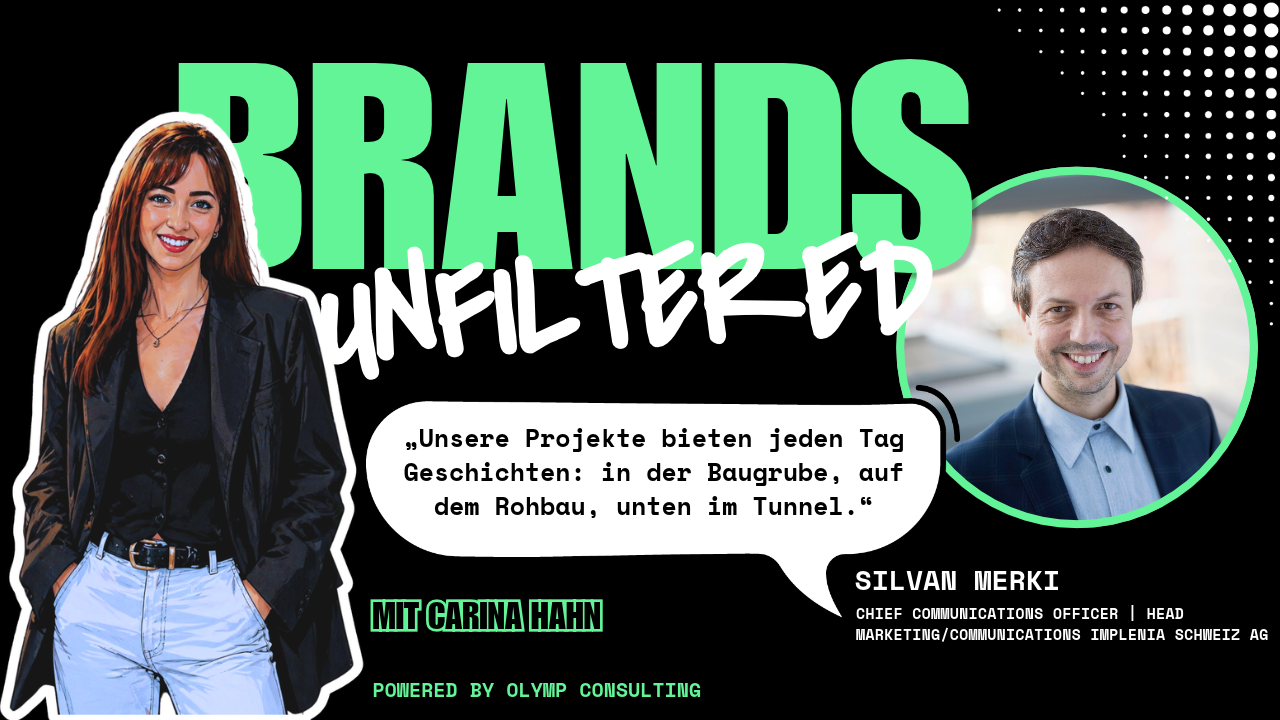
🎧 Du möchtest das Interview lieber anhören? Dann schau bei unserem Podcast vorbei:
05 Silvan Merki of Implenia Schweiz AG | On storytelling for megaprojects, a 20-person team for all of Europe, and communication that can be measured
Reading time: approx. 20 minutes
An interview by Carina Hahn with Silvan Merki, Chief Communications Officer and Head of Marketing/Communications at Implenia Schweiz AG
Silvan Merki heads marketing and communications at Implenia, one of Switzerland’s leading construction and real estate service providers. With a team of just 20 people, he is responsible for communications across all of Europe: integrated, strategic, and consistently measurable.
In conversation with Carina, he explains how his team turns gigantic tunnel projects, hospitals, and data centers into compelling stories that remain tangible over many years. He explains why data is built in from the very first concept, what role AI plays in his team’s day-to-day work, and how Implenia invited 5,000 employees, families, and clients from across Europe to a festival site in Zurich to celebrate its 160th anniversary.
Carina: To warm up, a few rapid-fire questions: podcasts or videos?
Silvan: Both. If it’s mostly just a conversation and not much is happening visually, audio is enough.
Carina: If you had to choose: risk a shitstorm or stay invisible?
Silvan: Shitstorm. Only those who provoke reactions are at least relevant.
Carina: Are you more of an early bird or a night owl?
Silvan: I’d like to be a night owl, or actually, I am a night owl. My role and my profession have turned me into an early bird.
Carina: Do you have a typical go-to when you’re out of ideas?
Silvan: When I have no ideas, I actually ask an AI these days. Otherwise, I ask people. I ask the room: we’re sitting here at Implenia’s headquarters in a large office, I stand in the middle and ask, because ideas come from people with different perspectives.
Carina: A very good tip: just as you ask AI, you can also ask people. Which social media platform do you spend the most time on?
Silvan: LinkedIn, clearly.
Carina: Then let’s dive right into the Implenia brand and your work there. How would you describe Implenia in three words?
Silvan: Competence. And large, relevant projects and services. Even if that was five words.
Carina: You have an exciting role, because you combine classic corporate communications and external marketing, two very large areas. What advantage does that bring Implenia, and why do you enjoy it?
Silvan: That was actually the reason I came to Implenia. In previous roles, I had marketing or communications teams reporting to me as their head. When this position was advertised and it was clear it covered both, it appealed to me enormously, partly because I had seen how much effort it often takes to coordinate the two. Under one leadership, it’s easier.
You said these are very large areas. At Implenia, a large construction and real estate service provider, it’s actually a small area again: I have 20 people working in marketing and communications across all the European countries we cover. Compared with other industries, that’s a small department, even when you combine marketing and communications.
And that’s exactly where the advantage lies. You can really think this way: whether it’s a market offering aimed at clients, corporate content for the broad opinion-forming public and the media, or financial market communication for investors, analysts, and banks, you can handle everything quite clearly using the same process. You always start with a topic. You attach goals and target groups to it, clarify the messages, the formats, and the instruments, and then plan the communication measures.
Regardless of whether it’s a market topic, a public opinion topic, or a financial market topic: at the back end, in production (text, images, film, compositing), across all our external and internal formats and instruments, you can then plan it very effectively and efficiently.
It’s like a specialized factory, a specialized process: at the front, topics are handled and concepts are developed; at the back, things are produced and we make sure that text, images, and film are in the right place, in all languages, in all countries, for all target groups. You can plan together and measure together, including what worked more efficiently and more effectively.
Carina: What I’m hearing is: you have an overview of the overall strategy, which lets you communicate more clearly that a message or goal is pursued across all channels, and in the end there’s less friction because fewer interfaces come together?
Silvan: Exactly: interfaces and divisions that don’t talk to each other. Implenia is a good size for this. It’s a really huge company, but we made this decision very deliberately because we’re very much in key account management. We’re not like a bank or a beverage manufacturer; we’re essentially in the project and mandate business.
We build large tunnels, large hospitals, data centers, or we manage entire sites, entire city districts, entire real estate portfolios. That’s very specialized. Strictly separating marketing and communications tasks and organizing them in large, diversified departments across the whole group simply makes less sense than leading them in a concentrated way, planning together, and jointly ensuring output and success.
Carina: Before this, you worked in a completely different field: at a very large bank and, before that, at an energy company, where marketing surely works differently again. What are the big differences, and what experience were you able to bring with you?
Silvan: The big differences really are the different businesses and, along with them, the different target groups and content. It depends heavily on whether you’re in a retail business, more of a B2B business, or a key account management business. That’s a big difference.
If you have many broad, fast-moving products that you basically offer to everyone, like electricity or banking products such as credit cards, accounts, pension accounts, ETFs, or savings plans, then those are products anyone can have at any time. You have a huge customer group that you can move from A to B with marketing and communications activities. You can certainly take a lot from that: how to tell stories, how to work with target groups.
With very large projects, on the other hand, you have very specific, clearly definable target groups. Not everyone orders a tunnel, a large hospital, or a data center every day. You can address these well-defined target groups more intensively, more clearly, and in a more targeted way, at every level, until the contract for the next project is signed.
If you’ve previously learned to segment target groups very clearly and well, you can bring that into the marketing and communications of a project service provider or real estate manager and do it even better, or align it even more clearly with business goals.
Carina: But you’re not entirely new to the industry; you’ve been at Implenia for seven years now. Take us through your day-to-day: what do you typically work on?
Silvan: We take the company’s strategy and look at which markets we operate in, where we currently are, where we want to go, and what our actual service offerings in the sales market are. There are three large divisions: Buildings, Civil Engineering, and Services.
Services essentially means: before a project, architecture, engineering, planning, sustainability planning, and building services planning; and after a project, property management. We do that with Wincasa, a second brand: Wincasa is the largest property manager in Switzerland, and Implenia acquired it. In between are the two large divisions, Buildings and Civil Engineering.
Buildings handles large, complex projects, nothing small-scale. Sites are developed and built there; hospitals, healthcare buildings, laboratory buildings, university campuses, and new data centers are built, where demand is still rising. So we build demanding properties that not everyone can build. We don’t enter price races where 30 or 40 construction companies are bidding; we go where it isn’t easy to build and where there’s less competition. Not everyone understands the requirements of a data center, for example the security requirements of the providers on the market. That’s written in English, and not every local construction company understands it. That’s where we’re strong.
In Civil Engineering, the second major pillar of the project business, it’s the large tunnels we build across Europe. We’re the only company involved in all the current Alpine crossings, from the Brenner through Lyon–Turin to the Gotthard. Add to that many bridges, roads, railways, station, commuter rail, and subway projects that we take from engineering through to handover, and then hand over to the city, the canton, the federal government, or the owner of the site or project.
Carina: So a typical part of your working day is developing the strategy and looking at which projects can be communicated how, what’s suitable, and how to put the different teams together?
Silvan: For me, the stories almost emerge on their own. That’s much easier than it was at the bank, where I had to tell a nice story about credit cards or a retirement savings plan. Our projects offer stories every day: in the excavation pit, on the shell construction, down in the tunnel. People are working on machines, something is being created, there are users.
That’s the easier part, meaning what I get in front of the camera, the lens, or into text. The demanding task is to create real business value with marketing and communications. In other words, what happens before the project: that we reach the right target groups with the right messages, so that they see Implenia or Wincasa as relevant for their next mandate, their next project. As the experts who can deliver.
We don’t want to define ourselves only by price, but by the fact that a project done with us has the right quality, is delivered within the targeted time frame and doesn’t take forever, as still often happens in construction. That in the end you have cost certainty, and what’s standing there is what you ordered, meets the requirements, is high quality, and was well managed.
Carina: An exciting thought, that the stories in your projects practically create themselves. Stories are still the heart of communication, even in the fast-paced world of marketing. Looking back on your seven years at Implenia: what has changed, and what has stayed the same?
Silvan: What has stayed the same is really the things we get to design and build on greenfield sites. Truly great projects have remained. Once you’ve stood on a tunnel boring machine that eats its way through the mountain like a submarine, those are stories that have stayed and will stay.
A great deal has changed in marketing and communications. That was also my mandate when I arrived: to professionalize and establish a process. How do we bring in the right stories? How do we tie marketing and communications to the strategy so that we pick the right topics, instead of reacting to every topic that comes along?
When someone says “I need a film about ABC,” we ask: where does ABC sit in the messaging house? What goal do we want to pursue? Who is really the target group? Which formats suit this target group? Where can they even be found? And then maybe a film isn’t the right thing at all, but something else: perhaps direct communication, perhaps even a meeting.
We approach every topic much more conceptually and have a clear process for how it’s planned, executed, and how success is measured. That’s very important, because many marketing and communications departments still don’t do this at all, do too little of it, or don’t do it as part of a continuous planning and measurement process.
With us, the output team looks at the numbers and what’s going on every single day. The business partners, who are more on the input and topic side, continuously check: are we strategically on the right track? Are we reaching the right audiences with the right topics, and getting the important engagement? Are we delivering, per topic, what we set out to achieve? That has changed enormously, and with it, what we actually produce.
When I started, we had shelves full of brochures on every service we offer. They never saw a client; no recipient ever held one in their hands. They stayed on the shelf. Now we produce pretty much exactly what we know will reach someone. If you’re always measuring and constantly trying to draw lessons from it, you soon know where you can still make adjustments to improve. Then the topic lands, has an impact, and may help us win or manage the next project better in line with the business portfolio. Our projects run for three, five, or ten years. A lot happens, projects change, and with good marketing and good communications we can contribute a great deal to things going better than if we simply built.
Carina: So you’ve moved strongly away from ad hoc communication toward strategic communication with foresight?
Silvan: Yes, with goals we want to achieve and with a process that still allows for ad hoc at any time. We have many topics that aren’t always pleasant. We have accidents on construction sites.
Then you have to have communication under control. On the day a really serious accident happens, you can’t loudly proclaim, “We have absolutely everything under control.” You have to be able to handle the topic in general, but on that day really make sure that no feelings are hurt, among the target groups or among the employees still working on the site while a colleague may be lying in hospital with something broken, and they don’t know whether he’ll come back to the site. That’s when it helps to have communication strategically oriented and under control, and marketing activities planned. Then you can deal much better with task forces and with crises that arise. Those who plan well and can play well from sheet music can usually also improvise better. You know that from music: the people who improvise well are simply very good musicians.
Carina: A very good point: planning with foresight, and precisely because of that being able to act spontaneously and flexibly.
Silvan: Exactly. Then you can separate topics that might conflict, combine topics that work better together, move topics forward or back, or change their tone and format.
Carina: With 20 people, you’re actually a very small team, and relative to that very efficient, active on many channels, and successful. I know that AI interests you a lot in general; that comes through in what you write. How has your area changed through AI and automation, and what role does it play in communication?
Silvan: That it’s no longer a separate area. Like with digitalization back then: when I started, there was a department called, I believe, “Digital Communications.” Deciding at the outset whether something is communicated digitally or not is, for me, a completely wrong approach, because it starts from the channel, not from the topic, the goal you attach to it, and the target group you’ve thought about beforehand.
Now every one of my business partners has to be able to take a topic from concept to output. And not just write, conceptualize, or maybe accompany a film shoot, but also with the AI tools. That’s where I have to, and can, show my boss: how does this become more efficient if we invest in 20 Claude licenses? What can we do more of, differently, or better? Where do we save on expenses, and where do we also save FTEs, meaning personnel costs? You have to be able to provide that proof. And the people who work for me have to be able to do it; otherwise, we have to go down that path together with them so they can.
Carina: Did this transition work well for you from the start? In marketing, openness to AI is often more widespread than in other areas. Was it a natural process, or did you first have to build understanding and run training?
Silvan: It became easy as soon as people took that first leap. Anyone who was perhaps afraid of writing a concept on a topic from a blank page, and then simply asked the AI for a concept, sees: wow, look at the raw material that comes back already. I can tweak that, I can align it, I can knead it until I put the bread in the oven. That person has a sense of achievement, and after that sense of achievement, AI gets used. That’s my experience.
The bigger change for marketing and communications people, at least on my team, was accepting that their work would be measured. Setting goals and continuously measuring every little piece of content that appears in any format, in any instrument, whether as a single element or as part of a campaign, against those goals, and then adjusting: the content, the format, or the instrument.
That was the much bigger change: bringing in data as early as possible, not only at the output stage but already at the input stage. When you think about which topics to develop, you already look at: what data is out there? How have topics performed in the arenas and markets? You work with that, build it into the goal-setting, measure immediately, and adjust if something potentially isn’t working.
That happens every day, and we don’t have a secret recipe either. But a day later you know what happened and what effect it had. You notice that, and you can adjust and correct. This ongoing process of good conceptual work, good planning, good measurement, and good learnings was probably the bigger challenge than introducing AI.
Carina: That’s why measurability is so important: it makes experimentation possible. You quickly see that something didn’t work, you gain that experience, and you can test something new, instead of just running blindly without knowing what effect something had. How do you measure? What are your most important KPIs, especially since so many touchpoints come together in marketing and you can’t always say exactly where a contact or lead came from?
Silvan: Exactly, you can’t always measure everything precisely. Still, my ambition is to be able to measure as well as possible. I keep asking my people to set up communications and marketing activities already at the concept stage of a topic, whether it’s sustainability, data center construction, or tunneling, so that every output and every interaction by the client or target group generates data. And above all, that we gain the best possible insights at the transitions from impressions to clicks to conversions, all the way to what we ultimately set as our goal.
You can imagine all kinds of data. For each topic, we usually map out an ecosystem: what goes out to a target group? What happens there? Where does the target group pass through, where do they end up? Then the aim is to measure what goes out from one instrument and comes in at another, and what ultimately results in interactions with clients. My ambition is to be able to measure the funnel or the journey as thoroughly as possible.
That doesn’t always work, and in the key account management business we’re in, it’s even harder. We have very small target groups, a lot goes through the tendering process or personally over the phone, and the touchpoints are further apart in time. From when we submit a bid for a project until the contract is awarded, being able to measure exactly where it clicked or where the decisive client interaction happened is difficult. The bottom-of-funnel conversion on the client side is very, very hard for us to measure.
Further up, as far as engagement and interaction go, meaning how we interact with clients and what happens there and why, it can be traced fairly well. On the employee side, we can measure very well: on TikTok, when people land on LinkedIn, when they click through to the jobs, all the way to the application. Did we hire them? Did we hire the right ones? Did they stay? We measure quite far down there. That’s possible now if you link the touchpoints, load them into the data lake, pull the data back out, and attach it thematically to the chain. Then you can measure fairly well what a marketing and communications activity contributed in the employee journey, from application to hiring.
Carina: Anyone who maintains their CRM really well and records the touchpoints can, with a certain amount of data, run analyses, including with AI, and identify trends. For example: we lose contact in the middle phase, so we need stronger touchpoints or different formats there.
Silvan: That’s clearly easier where you sell small-ticket products. At the bank where I worked before, you could measure for every campaign what it produced at the bottom in terms of sales: accounts, credit cards, funds, securities account openings, retirement planning accounts, measured all the way through to the account opening.
In the key account, project, and mandate business we’re in, we do it as far as we can. But we make sure that the effort spent on measuring isn’t greater than the activity itself. So we always set things up so that data is generated, aggregated, and interpreted as automatically as possible. Otherwise you measure yourself to death, or you measure for the sake of measuring. We measure what we set as a goal for each campaign and can measure with reasonably sensible effort.
Carina: When I look at the performance of your marketing channels and compare it with some larger companies in the industry, you have very strong performance for your team size. What’s your secret sauce?
Silvan: It really is the integrated approach. We have little friction in the factory. And we’re good at showing our content, telling the stories that happen there, and finding the right stories.
I could tell a thousand stories every day about every apprentice, every employee, every manager here. But when a topic comes in, we align it very strongly with a messaging house built on the corporate strategy. The messaging house is nothing more than the company’s vision, mission, strategic priorities, and values. We connect that with a few highlight projects that stand as examples, and we follow those continuously.
With projects, too, I could get lost: we have maybe four to five thousand projects underway across Europe, it fluctuates. One project is in the excavation pit, another in the shell construction phase, another almost finished. When I look at which projects exemplify what we want to communicate and market, I can accompany a project with communications over a long period: from the greenfield site, from planning, from the first client interaction and the signing of the contract, through to handover. And in the best case, there’s also a client who is thrilled, with what’s standing there and with the collaboration with Implenia, Wincasa, or another of our brands over four, five, six, eight, or ten years.
Carina: Fascinating, that way people can also identify with a story. I often see companies make the mistake of only publishing a nice post or news article at the end of a project: “That was a successful project, we’re delighted.” But that’s not a story that grips anyone. You have a 160-year history overall and recently held a very impressive celebration. Tell us what it meant and what was special about it.
Silvan: The brand is only 20 years old and therefore actually still young, but together with all the predecessor companies that merged into it, it’s more than 160 years. We asked ourselves: do we publish a big book for the anniversary? Do we simply invite our few most important clients? What do we do? We decided to tell stories throughout the entire anniversary year, not simply chronologically, what happened in which year, but very thematically. For example, how we built at practically every Swiss airport, at many German airports, and even at airports on exotic islands in the Mediterranean. Sixty years ago, runways were built there when flying was just taking off and was something completely new. Or: housing shortages were already an issue in the 1960s and 1970s. Even then we offered great solutions for putting up a lot of housing quickly. The topic was relevant then, and it’s relevant today: today we modernize and renovate those buildings and manage them with Wincasa.
Or the entire energy infrastructure: from the first run-of-river power plant on the Rhine to the first dam in the Alps, through to today’s modernization of these power plants or new dams we’re building. These are historical threads we can tell. And then we said: now we’ll also celebrate for once. We do that very rarely. Our headquarters is relatively small compared with the size of the company as a whole; after one or two levels, you’re straight out on the projects. So in the container village in Paris where the metro is being built, or up in the mountains at the Gotthard, where the road tunnel will soon be built. We wanted to let these people celebrate together for once, at a cool venue, with a great program, with lots of history, but above all with lots of future.
That’s why the motto was “20 years young – 160 years of shaping the future.” Because it was always about the future: building airports, mobility, the energy future we were fortunate to help shape. We held a big celebration and invited 5,000 people from all over Europe. People were also allowed to bring their families. That’s often the case with us: a tunnel builder spends several days at a stretch on his project and isn’t with his family. He does have time off and often travels back to his family, or the family moves along with every project. Or they simply miss each other over long periods. That’s why we wanted to invite the families too. And we invited clients.
We were able to create many wonderful experiences: getting on buses in Frankfurt in the morning and arriving at a festival site in the middle of Zurich. Hearing the best bands. Getting food from 35 food trucks. Operating small excavators remotely or driving big ones together. Getting into conversation with each other, when normally everyone is on their own project, sitting with their own team, or just making sure the next kilometer of tunnel gets drilled, and they’ve never been together. We received wonderful feedback, especially from people who traveled in from other places and had a lovely day in Zurich.
Carina: Those are moments that connect people on a completely different level and that tell stories in their own way.
Silvan: Exactly, they stay with you. And the clients saw it. It was important to us that they see what strength Implenia has. Clients often only see their project manager, maybe the sub-project managers or the site managers. And there, for once, the clients saw the whole Implenia family together.
Carina: A final question that perhaps goes in a similar direction: was there a particular highlight in the last seven years, a project or something else, that has stuck in your mind and that you always enjoy talking about?
Silvan: Of course, I just got to organize the biggest and most complex celebration I’ve organized here. I’ve organized big parties for big companies before, but this was probably the most complex and varied celebration. I won’t forget it any time soon.
But communication and marketing are always easy when things are going well. When the company isn’t yet on the path it should be on, that’s where a lot of memories come from. How we also had to prepare difficult topics communicatively so that we could tell and explain them well: why are we where we are? Why are we perhaps not yet where we want to be? Where do we want to go? How do we walk the path together? What is our strategy, even if we’re not there yet?
Through a transformation, with good, open, and as clear as possible communication about what could be said, we were then able to move into the company’s next phase. That’s why we’re now on a growth path and no longer in a transformation, and we can build on what we’ve created. Of course, it was above all the company itself that created it, but we were able to support it well with good marketing activities and good communications. That will stay with me as a whole, alongside the wonderful celebration that took place recently.
Carina: So communication includes both: creating offline experiences, but also conveying crisis communication, or generally complex, more difficult communication, in an approachable and successful way.
Silvan: Another big topic within communications was the task forces during Covid: coping with regulations across Europe that changed daily, sometimes twice a day. We suddenly expanded from four to eight languages, because our people on the construction sites needed to know immediately: how long are they allowed to work with a colleague at the elevator shaft? How far apart do they have to sit when eating together in the container? Which tools may they use and for how long, and how do they have to treat them afterward? Do the sites need to be cleaned this way or that way?
That was an extremely intense phase, but one in which we could also show what internal communications can achieve and how it helps the business function well. We were very glad to have a good set of instruments to reach our people at all. We’re not a homogeneous workforce where everyone has a login. We have many blue-collar employees, many teams who are simply out on construction sites, and we’re often in joint ventures with other companies on the sites.
It was really great to see how it worked: that what you communicated was seen immediately. We also set up feedback channels: where do you need help, where do you need support? Do you know how you need to work today? Even in those difficult phases, when some sites were closed while others still worked brilliantly.
Carina: Thank you very much for your time and these fascinating insights. I’ll definitely keep following your projects with great interest.
Silvan: My pleasure. It was fun. Thank you.
About the guest: Silvan Merki